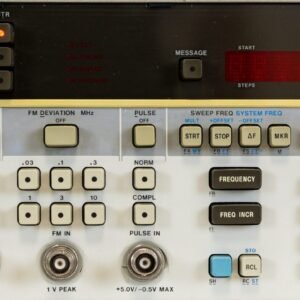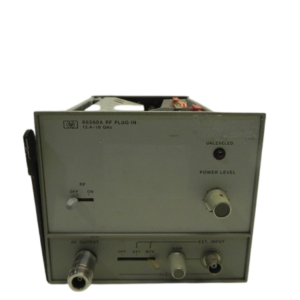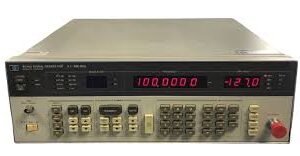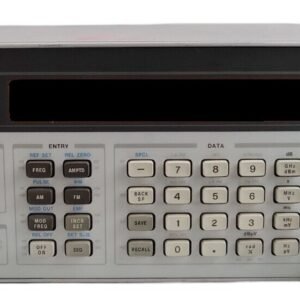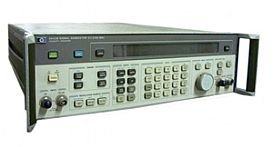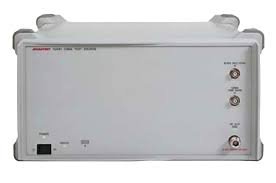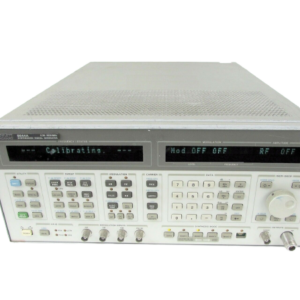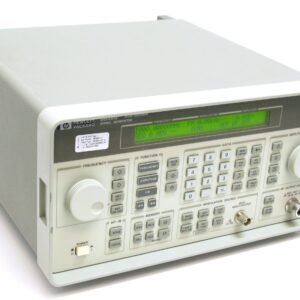
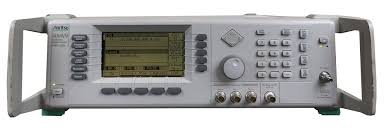

The Anritsu 69053A is a synthesized CW generator delivering stable, phase-coherent signals across 10 MHz to 65 GHz for RF and millimeter-wave testing. Single coaxial output with output power from -125 dBm to +17 dBm and ultra-low phase noise of -100 dBc/Hz at 10 kHz offset (referenced at 10 GHz) makes it suited for component characterization, system integration, and automated test environments. Frequency resolution of 1 kHz standard (0.1 Hz with Option 11) and 50 Ω output impedance ensure precision across its full range.
Technical Specifications
• Frequency Range: 10 MHz to 65 GHz (single coaxial output)
• Output Power: -125 dBm to +17 dBm maximum
• Phase Noise: -100 dBc/Hz SSB at 10 kHz offset from 10 GHz
• Frequency Resolution: 1 kHz standard; 0.1 Hz with Option 11
• Output Impedance: 50 Ω
• Harmonic Content: -40 dBc (harmonic and non-harmonic noise)
– Key Features
• CW stimulus output with step sweep capability (1 to 10,000 steps)
• Step size configurable from 1 kHz to full frequency range; dwell time 1 ms to 99 seconds
• Frequency switching time less than 15 ms + 1 ms/GHz step size (typical maximum 40 ms)
• Alternate sweep mode between two ranges with independent power level assignment per range
• Manual sweep with phase-locked frequency tuning between limits
• Internal AM, FM, phase modulation, and pulse modulation; supports user-downloaded complex modulation
• Pulse modulation via internal generator or external control (doublet, triplet, quadruplet configurations)
• Simultaneous synchronized modulations for complex signal generation
• GPIB control interface with SCPI and native Anritsu command support
• Waveguide extensions available to 110 GHz
– Typical Applications
• Component characterization and validation at millimeter-wave frequencies
• System integration and subsystem testing
• Automated test system stimulus source
• Phase noise and spectral purity validation
– Compatibility & Integration
GPIB control enables integration into automated test environments. Option 11 provides 0.1 Hz resolution for ultra-fine frequency tuning requirements.