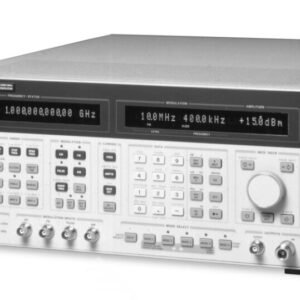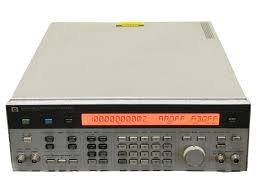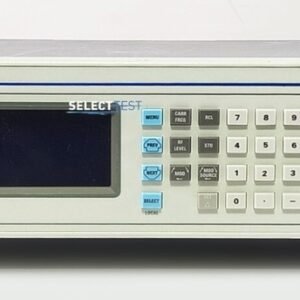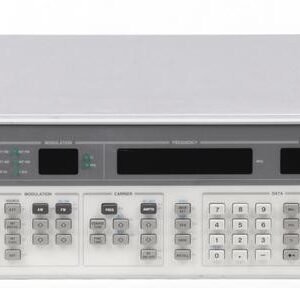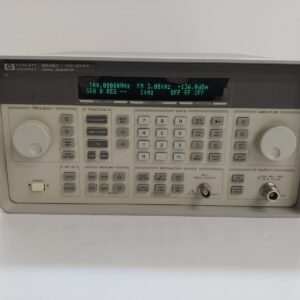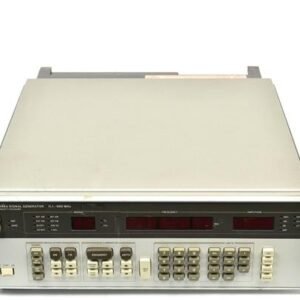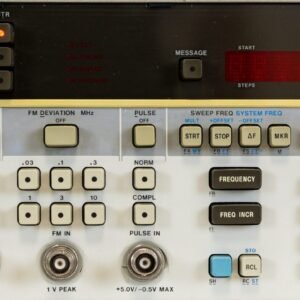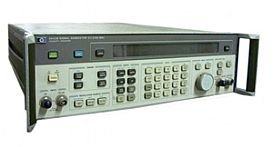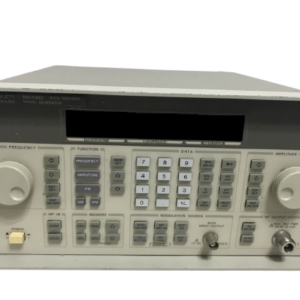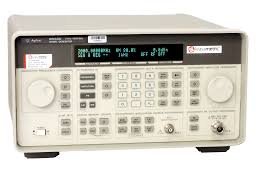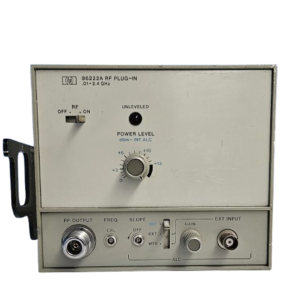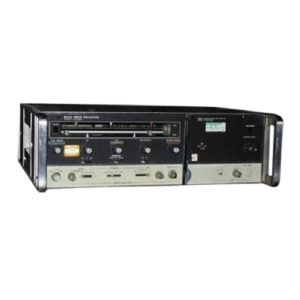
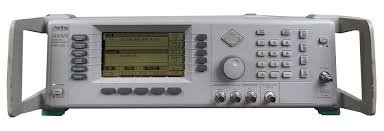

The Anritsu 69285A is a synthesized signal generator delivering precise RF and microwave signal generation from 0.05 GHz to 60.0 GHz. Built for R&D, manufacturing, and field maintenance in microwave and millimeter-wave communications, it combines frequency synthesis architecture with exceptional signal purity and stability. The instrument supports amplitude, frequency, and pulse modulation alongside linear and logarithmic frequency sweeps, making it essential for component characterization, system integration, and signal validation across the microwave spectrum.
Technical Specifications
Frequency Range: 0.05 GHz to 60.0 GHz
Frequency Resolution: 0.001 Hz
Output Power Range: −120 dBm to +20 dBm (frequency-dependent)
Output Power Accuracy: ±0.5 dB
Output Power Flatness: ±0.5 dB across specified bands
Output Impedance: 50 Ohms
Phase Noise: −100 dBc/Hz at 10 kHz offset (at 10 GHz reference)
Harmonic Distortion: Better than −30 dBc
Spurious Outputs: Less than −60 dBc
Modulation—AM: 0% to 100% depth, DC to 100 kHz modulation frequency
Modulation—FM: DC to 100 kHz modulation frequency, variable deviation
Modulation—Pulse: >70 dB on/off ratio, variable pulse width to nanosecond resolution, variable PRF
Digital Modulation: QPSK, QAM support (option-dependent)
Sweep Modes: Linear and logarithmic frequency sweep; continuous, triggered, and single-sweep operation
Internal Reference: 10 MHz
External Reference Input: 10 MHz
Reference Output: 10 MHz
– Key Features
• Synthesized architecture ensures signal stability and repeatability across full frequency span
• Sub-hertz frequency resolution for precise tuning and characterization
• Wideband output flatness and low spurious content suitable for demanding RF applications
• Flexible modulation—analog (AM/FM), pulse, and digital schemes
• Multiple sweep profiles for component gain/loss measurement and frequency-response mapping
• Dual reference capability: internal 10 MHz oscillator with external input option
– Typical Applications
• Microwave and millimeter-wave component testing
• Receiver and transmitter validation
• Filter and amplifier characterization
• Communications system integration and bench verification
• Field service and maintenance of RF subsystems
– Compatibility & Integration
Front-panel control via keypad and rotary encoder; remote instrument control supported via standard interfaces.