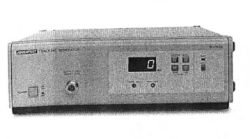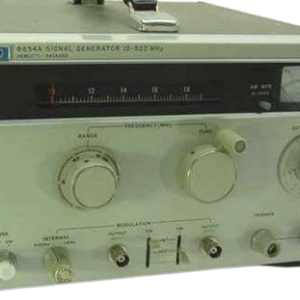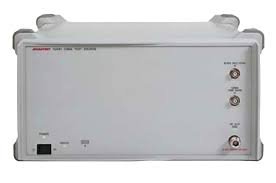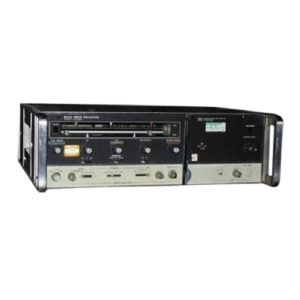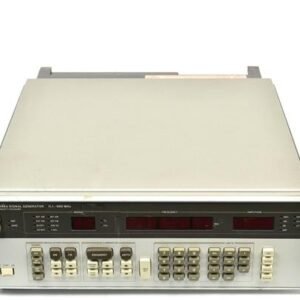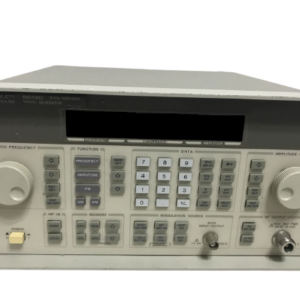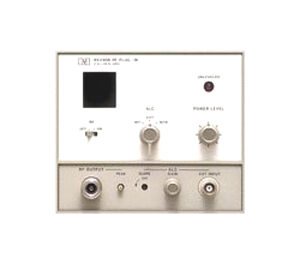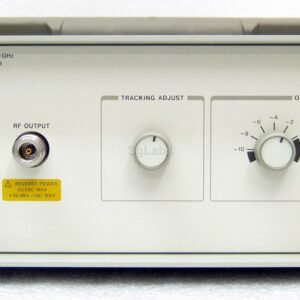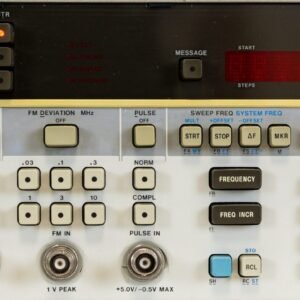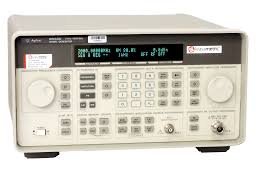
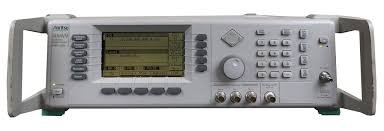

The Anritsu 69375A is a synthesized sweep/signal generator covering 0.5 to 50 GHz, engineered for RF component testing and system-level verification across aerospace, defense, telecommunications, and semiconductor applications. It delivers frequency agility with stable output power in demanding microwave environments.
Technical Specifications
• Frequency Range: 0.5 GHz to 50 GHz
• Sweep Modes: Analog, step, and manual sweep with synthesized phase-locked operation
• Step Sweep: Variable steps (1 to 10,000) with adjustable step size and dwell time per step
• Manual Sweep: Stepped, phase-locked frequency adjustment between defined sweep limits
• Alternate Sweep: Dual-range sweep capability with independent power levels per range
• List Sweep Mode: Multiple frequency/power table storage with phase-locked step execution and non-volatile memory
• Frequency Agility: Programmable storage and addressing of non-sequential frequencies
• Modulation Support: Internal AM, FM, phase, and pulse modulation; user-downloadable complex modulation available on select configurations
– Key Features
• Phase-locked synthesized architecture ensures frequency stability across the full 0.5–50 GHz range
• Multiple sweep topologies enable flexible test sequencing from simple linear sweeps to complex multi-state patterns
• List mode with non-volatile storage supports repetitive test automation
• Modulation flexibility supports both standard and custom signal formats
• 50 Ohm output impedance (standard RF configuration)
– Typical Applications
• Component characterization and S-parameter measurement
• Receiver and transmitter system validation
• Frequency response testing of RF subsystems
• Modulated signal generation for communication system test
• Phase-locked frequency switching in automated test sequences
– Compatibility & Integration
The 69375A integrates into automated test systems through programmable sweep control, list mode sequencing, and phase-locked frequency switching. Non-volatile storage enables autonomous multi-step test execution without host system intervention between measurement cycles.