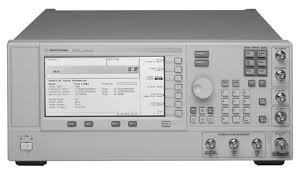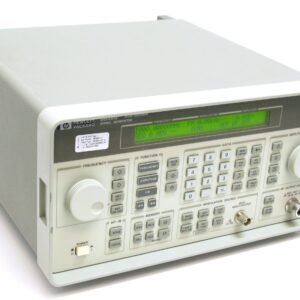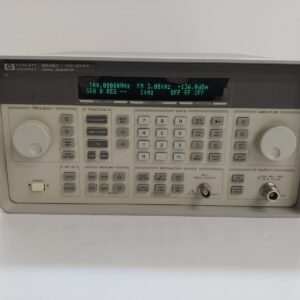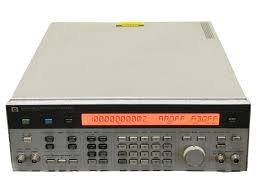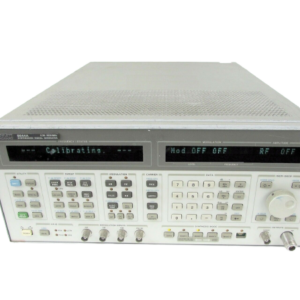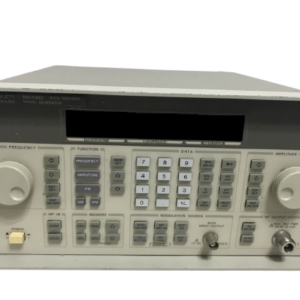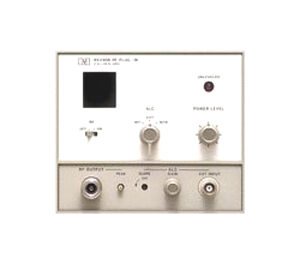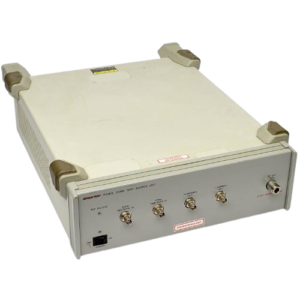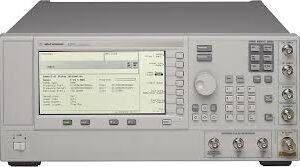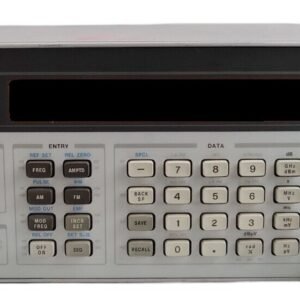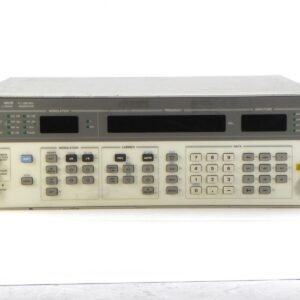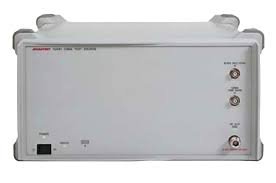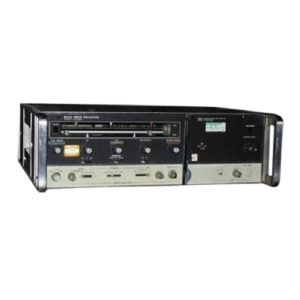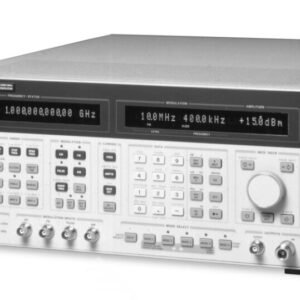
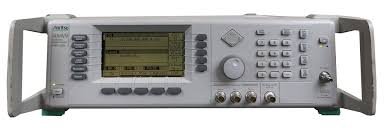

The Anritsu 69387A is a synthesized sweep/signal generator delivering precise signal generation from 0.01 GHz to 60 GHz. Built for RF/microwave system analysis and validation, it combines ultra-low phase noise with rapid frequency tuning and sophisticated modulation capabilities. The instrument executes complex measurement scenarios through step and analog sweep modes, pulse modulation with configurable waveforms, and synchronized multi-modulation control.
Technical Specifications
Frequency Range: 0.01 GHz to 60 GHz
Tuning Speed: Typically less than 40 ms to settle within 1 kHz of final frequency. Step sweep maximum switching time is less than 15 ms + 1 ms/GHz step size, or less than 40 ms, whichever is smaller.
Phase Noise: Ultra-low SSB phase noise at -100 dBc (10 kHz offset from 10 GHz).
Time Base Accuracy: Stability depends on 10 MHz reference. Aging: < 2 × 10⁻⁸/day standard (< 5 × 10⁻¹⁰/day with Option 16). Temperature stability: < 2 × 10⁻⁸/°C across 0°C to 55°C (< 2 × 10⁻¹⁰/°C with Option 16).
Reference Output: 10 MHz reference, 0.5 V p-p into 50 Ω, AC coupled, rear-panel BNC.
– Key Features
• Step Sweep: 1 to 10,000 selectable steps with 1 kHz step resolution (0.1 Hz with Option 11); variable dwell time from 1 ms to 99 seconds
• Analog Frequency Sweep: Sweep width selectable from 1 MHz to full 60 GHz range
• Modulation: Internal AM, FM, Phase, and Pulse modulation with up to 7 waveforms including user-defined arbitrary waveforms
• Pulse Capabilities: Configurable doublet, triplet, and quadruplet pulse generation for radar blind spot testing; internal or external parameter control
• Synchronized Modulation: Simultaneous multi-modulation for complex signal generation across full frequency range
• Sweep Triggering: Auto, External (TTL low-to-high), and Single modes for analog frequency sweep, step sweep, and CW power sweep
• External 10 MHz Reference Input: Accepts external time base
• TTL Triggering: Auxiliary I/O for sweep control
• GPIB Control: Supports up to 1000 non-sequential addresses
– Typical Applications
Communication system validation, receiver testing, radar system analysis, and electronic component characterization across X-, Ku-, and Ka-band frequencies.
– Compatibility & Integration
GPIB-addressable instrument with external reference clock capability and TTL trigger support for automated test sequences.