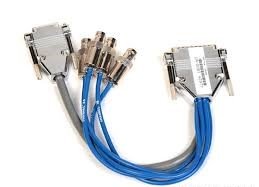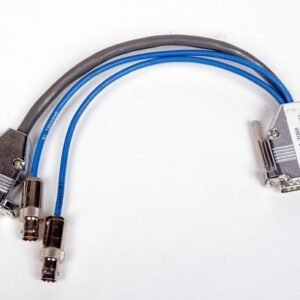
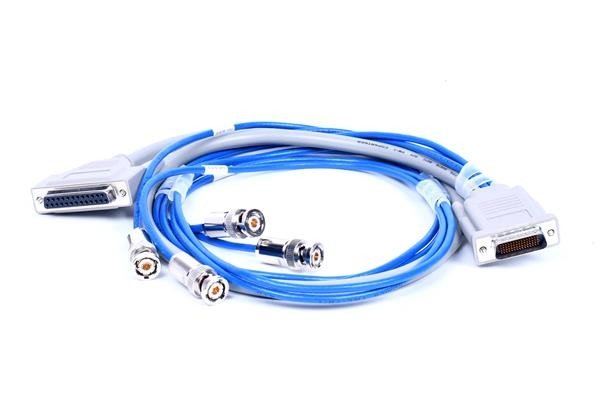

The Astronics / Ballard Technology 16037 is a 3-foot cable assembly that bridges Low Force Helix (LFH) connectors to MIL-STD-1553 Twinax data buses. It terminates with four connectors: one LFH interface on the source end and two MIL-STD-1553 Twinax connectors plus one 25-pin D-Sub connector on the terminating end. This configuration supports primary and redundant 1553B bus connections alongside auxiliary signal routing for IRIG time synchronization or discrete I/O, making it well-suited for avionics and military systems requiring dual-bus architecture with supplemental control signals.
## Technical Specifications
• Manufacturer: Astronics / Ballard Technology
• Model: 16037
• Cable Length: 3 feet
• Cable Type: MIL-STD-1553B Twinax coaxial cable
• Impedance: 78 Ω (nominal)
• Voltage Rating: 400 Vrms maximum
• Operating Temperature Range: −55°C to 165°C
• Compliance: MIL-STD-1553B Twinax
## Key Features
• Low Force Helix (LFH) source connector—60-pin configuration with four rows of 15 pins for high-density signal distribution
• Dual MIL-STD-1553 Twinax connectors with bayonet or threaded couplings for secure, vibration-resistant terminations
• 25-pin D-Sub (DB25) connector for application-specific auxiliary signals including IRIG AM/PWM and discrete avionics I/O
• Twinax construction with 78 Ω characteristic impedance ensures signal integrity across MIL-STD-1553B bus networks
• Temperature-rated for extended aerospace and defense environmental operating ranges
## Typical Applications
• Avionics data bus distribution where primary and redundant 1553B channels require independent connectors
• Military systems integrating LFH-based backplane or midplane interconnects with external 1553 bus architecture
• Aircraft and spacecraft control systems requiring dual-channel redundancy plus auxiliary time-sync or discrete signal support
• Integration with MIL-STD-1553 interface cards and modules in modular avionics platforms
## Compatibility & Integration
This assembly is designed for systems and hardware utilizing LFH connectors paired with standard MIL-STD-1553 Twinax bus interfaces. It integrates with existing MIL-STD-1553B interface cards, avionics backplanes equipped with LFH connectors, and systems requiring separate discrete I/O or IRIG signal pathways.