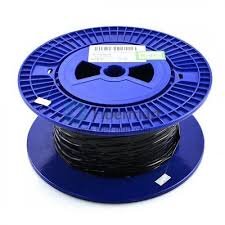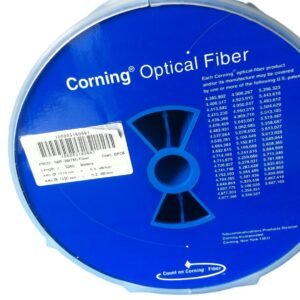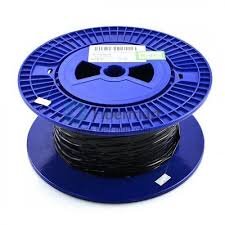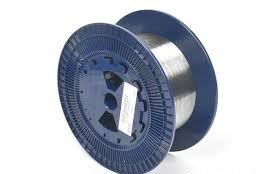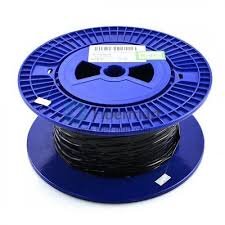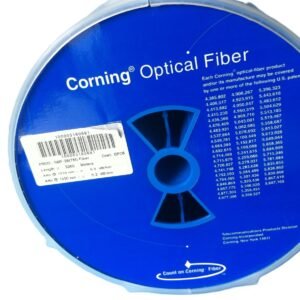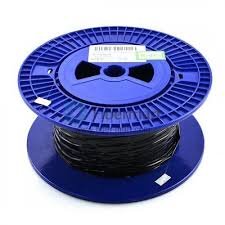
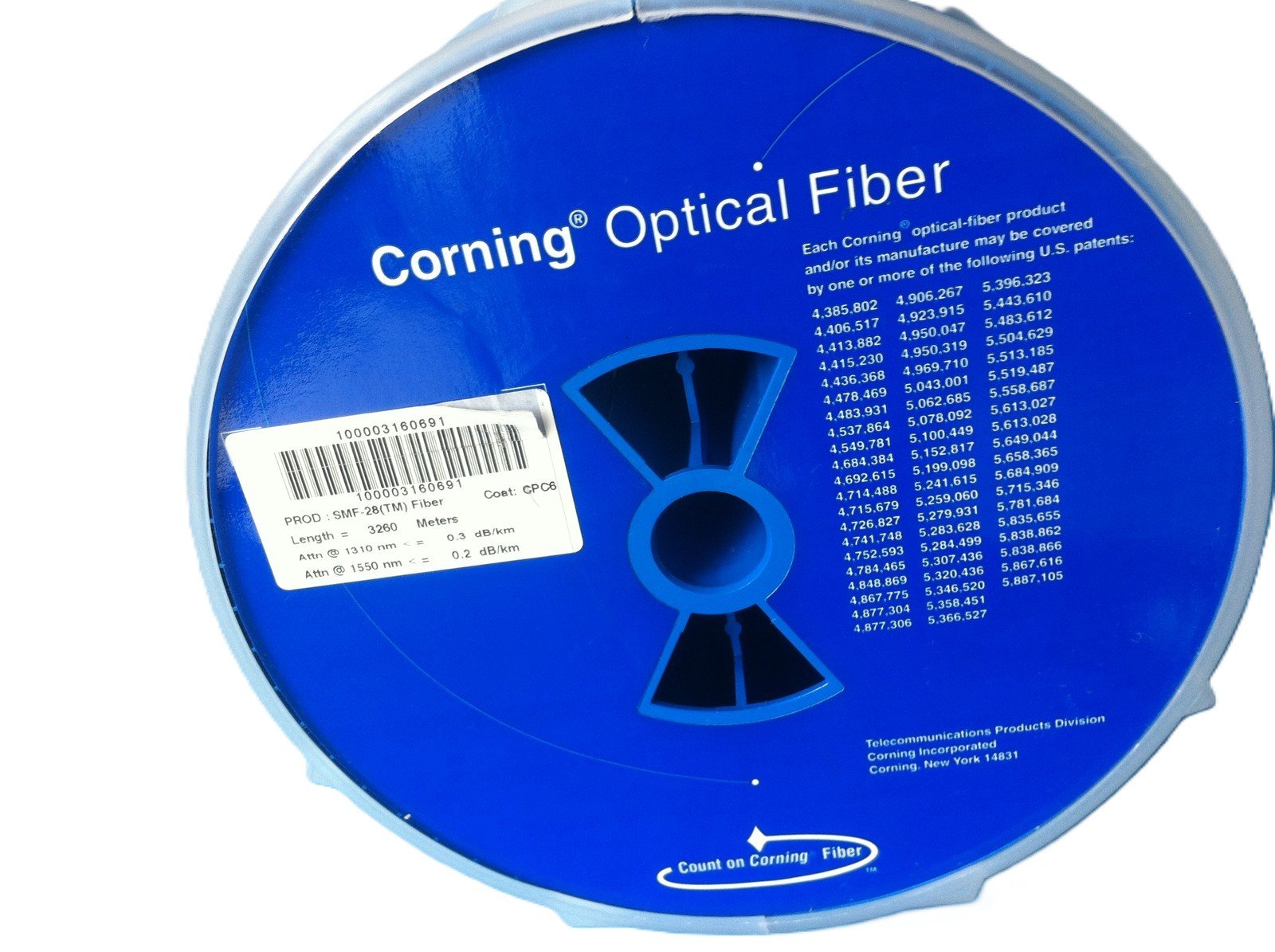

The Corning LEAF® Optical Bare Fiber is a non-zero dispersion-shifted fiber (NZDSF) engineered for long-haul and ultra-long-haul DWDM systems. This 15 km spool reduces nonlinear effects through its large effective area (>70 µm²), enabling higher transmission capacities across 10 Gb/s, 40 Gb/s, and 100 Gb/s networks. LEAF fiber meets ITU-T G.655.D, IEC 60793-2-50 Type B4, Telcordia GR-20-CORE, and TIA/EIA 492-EA00 standards.
Technical Specifications
Optical Characteristics
• Attenuation at 1550 nm: ≤ 0.19 dB/km
• Attenuation at 1625 nm: ≤ 0.21 dB/km
• Attenuation at 1450 nm: ≤ 0.26 dB/km
• Attenuation at 1410 nm: ≤ 0.32 dB/km
• Attenuation at 1383 nm: ≤ 0.4 dB/km
• Dispersion at 1530 nm: 2.0 to 5.5 ps/(nm•km)
• Dispersion at 1565 nm: 4.5 to 6.0 ps/(nm•km)
• Dispersion at 1625 nm: 5.8 to 11.2 ps/(nm•km)
• Mode Field Diameter at 1550 nm: 9.2 to 10.0 µm
• Effective Area: >70 µm²
• Numerical Aperture: 0.14 NA
Transmission Performance
• PMD Link Design Value: ≤ 0.04 ps/√km
• Maximum Individual Fiber PMD: ≤ 0.1 ps/√km
• Macrobend Loss (16 mm mandrel, 1 turn): ≤ 0.50 dB at 1550 nm and 1625 nm
• Macrobend Loss (30 mm mandrel, 100 turns): ≤ 0.05 dB at 1550 nm and 1625 nm
• Point Discontinuity: ≤ 0.05 dB at 1550 nm
– Key Features
• Large effective area minimizes nonlinear impairments in high-power transmission
• Flat attenuation profile across C- and L-bands supports extended wavelength operation
• Low PMD design complies with ITU-T G.650-2 Appendix IV requirements
• Proven deployment history as the world’s most widely deployed NZDSF
– Typical Applications
• Long-haul DWDM telecommunications networks
• Ultra-long-haul submarine cable systems
• High-capacity backbone infrastructure
– Compatibility & Integration
This fiber integrates into networks built on ITU-T G.655.D architecture and complies with Telcordia and TIA/EIA standards for telecommunications-grade optical fiber.