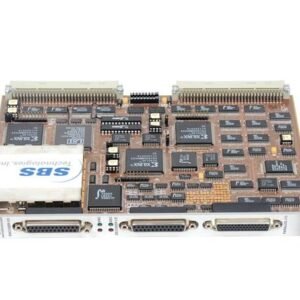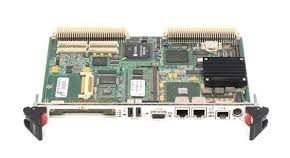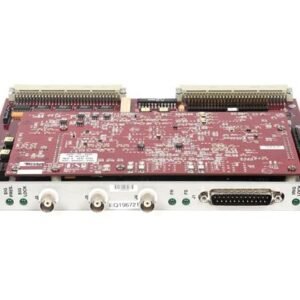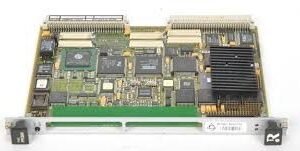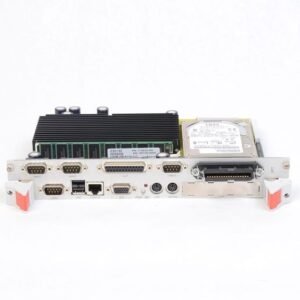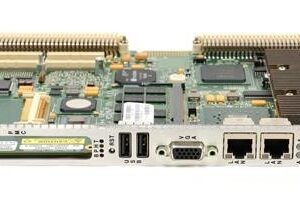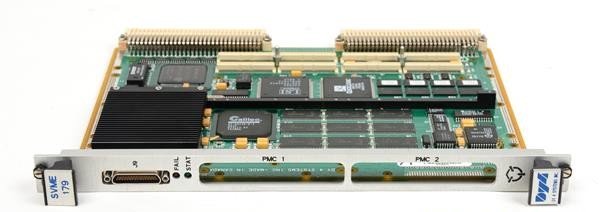

The Curtiss-Wright/DY-4 SVME-179-000 is a MIL-rugged single board computer engineered for high-performance embedded applications in defense and aerospace environments. Built on a fully 64-bit PowerPC architecture, it delivers processing power up to 400 MHz with selectable CPU options: PowerPC 750 or PowerPC 7400 with AltiVec Technology Enhancement. The board combines fast memory hierarchy, extensive I/O connectivity, and VMEbus integration for mission-critical avionics, tactical vehicles, and naval systems.
## Technical Specifications
**Processor Core**
• CPU: PowerPC 750 or PowerPC 7400 (AltiVec-enhanced)
• Frequency: Up to 400 MHz
• L2 Cache: 1 MB (750) or 2 MB (7400), synchronous burst RAM, parity detection
• Peak L2 bandwidth: 1.064 Gbytes/sec at 133 MHz
**Memory Configuration**
• SDRAM: 64, 128, or 256 MB with ECC
• Peak processor-memory bandwidth: 528 Mbytes/sec
• Flash: Up to 48 MB, 64-bit wide, direct memory-mapped, code-executable
• nvSRAM: 32 KB AutoStore
• Serial EEPROM: 512 bytes
**Bus Architecture & Interfaces**
• 64-bit PCI local bus (264 Mbytes/sec peak throughput)
• Tundra Universe II VME64 master/slave interface
• Two IEEE P1386/1386.1 64-bit PMC sites @ 33 MHz
**I/O Interfaces**
• 10/100BaseTX Ethernet (IEEE 802.3)
• Ultra SCSI (8 or 16-bit): 20 Mbytes/sec synchronous, 7 Mbytes/sec asynchronous
• Serial: Two EIA-232 ports (50–115.2 Kbps programmable); two EIA-422/485 HDLC/SDLC channels with optional DMA
## Key Features
• Direct code execution from 48 MB Flash minimizes boot latency
• ECC-protected SDRAM for data integrity in harsh environments
• Dual PMC expansion sites enable flexible I/O modularity
• DRAM accessible from processor, PCI, and VMEbus paths
• Front-panel and backplane Ethernet connectivity options
## Typical Applications
• Avionics systems
• Tactical ground vehicle controllers
• Naval shipboard computing
• Defense embedded platforms requiring MIL-spec reliability
## Compatibility & Integration
The SVME-179-000 integrates into VME systems via Universe II bridging and supports mixed-width SCSI configurations (SCSI-2 and SCSI-3). Memory accessibility from multiple bus masters enables coherent multi-processor designs.