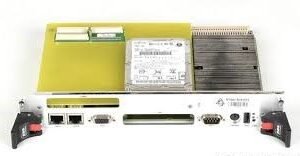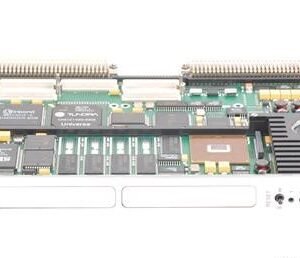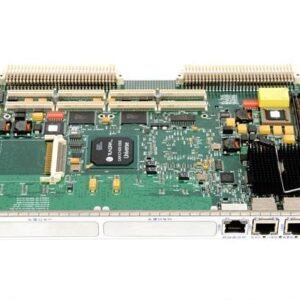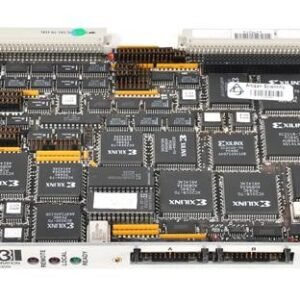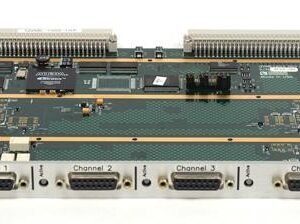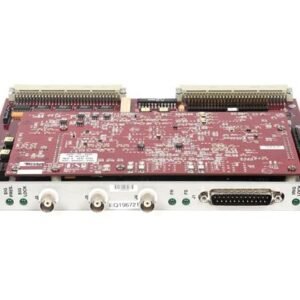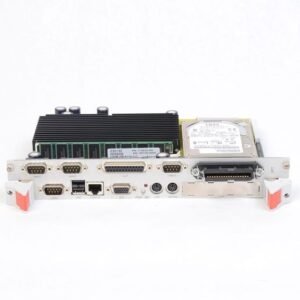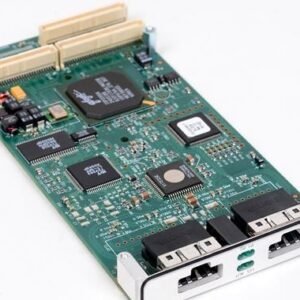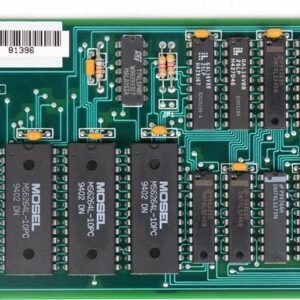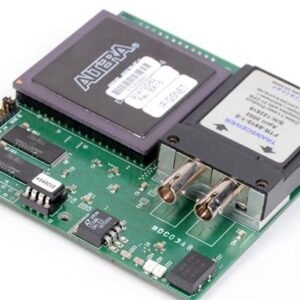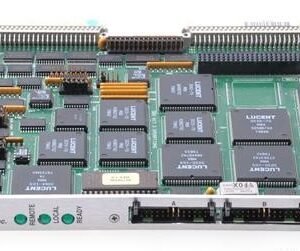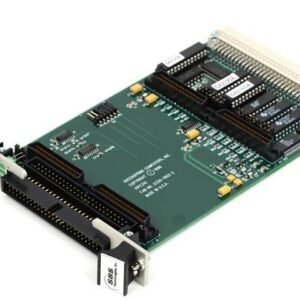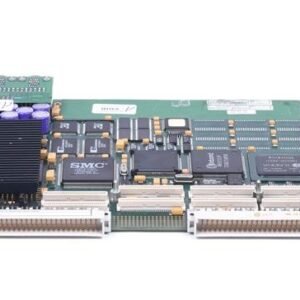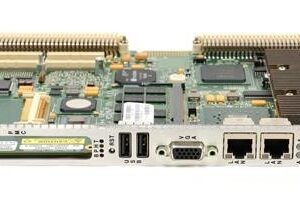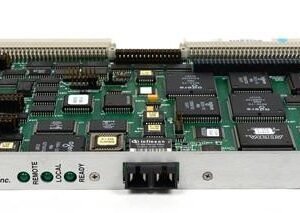
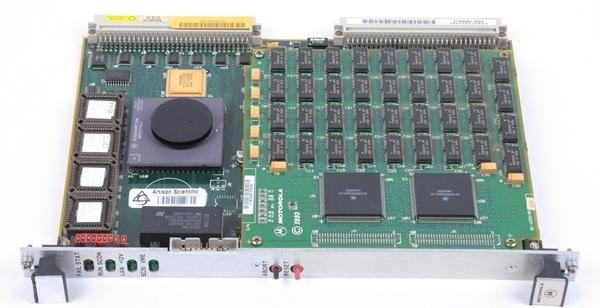

The Emerson/Motorola MVME167-02 is a VMEbus-based single-board computer built around the Motorola MC68040 microprocessor for industrial and embedded control systems. Operating at 25 MHz or 33 MHz with integrated MMU and FPU, it delivers 27.7 MIPS or 36.8 MIPS respectively and supports floating-point operations at 3.5 MFLOPS or 4.5 MFLOPS. The board combines an 8 KB on-chip L1 cache with configurable DRAM from 4 MB to 128 MB, plus 128 KB of SRAM and up to 4 MB of ROM/EPROM, enabling flexible memory architectures for demanding applications.
## Technical Specifications
• **Microprocessor:** Motorola MC68040 @ 25 MHz or 33 MHz
• **Performance:** 27.7 MIPS @ 25 MHz / 36.8 MIPS @ 33 MHz (Dhrystone 1.1); 3.5 MFLOPS @ 25 MHz / 4.5 MFLOPS @ 33 MHz
• **Cache:** 8 KB L1 (4 KB instruction + 4 KB data)
• **DRAM:** 4 MB to 128 MB configurable; supports parity or ECC; four-way interleaved; mezzanine modules extend to 256 MB ECC or 64 MB parity
• **ROM/EPROM:** Four 44-pin PLCC sockets, up to 4 MB total (512k x 16-bit)
• **SRAM:** 128 KB; 8 KB NVRAM with real-time clock/calendar
• **VMEbus:** IEEE 1014 compliant, 32-bit master/slave, D64/BLT, D64/MBLT, D16/BLT support; system controller, interrupter, and interrupt handler capable; GCSR for interprocessor communication
• **DMA:** High-performance controller; VMEbus D64 and local bus burst cycles; SCSI and Ethernet DMA (32-bit local bus)
## Key Features
• Four EIA-232-D serial ports (38.4K bps asynchronous, 64K bps synchronous)
• 8-bit bidirectional Centronics-compatible parallel port
• On-board SCSI bus interface with 32-bit local bus burst DMA
• On-board Ethernet interface
• M68000 family software compatibility
## Typical Applications
Process control, data acquisition systems, industrial automation, embedded computing platforms, and VME-based instrumentation requiring high computational throughput with flexible I/O connectivity.
## Compatibility & Integration
Full VMEbus integration with existing M68000 ecosystem; supports both VMEbus block transfer modes and peripheral interfacing through serial, parallel, SCSI, and Ethernet channels.