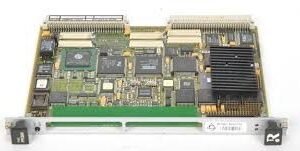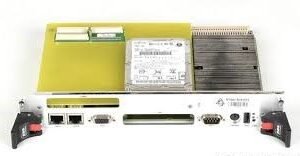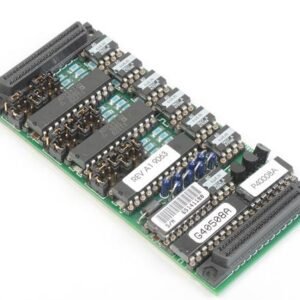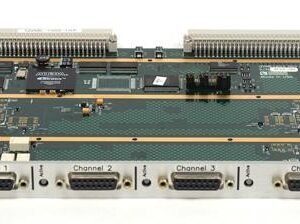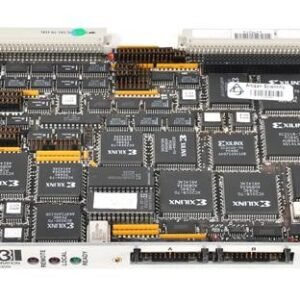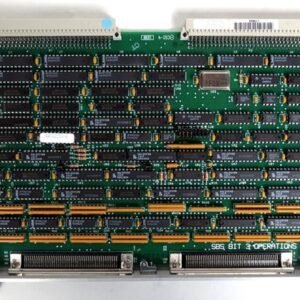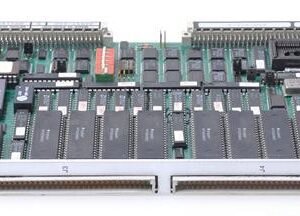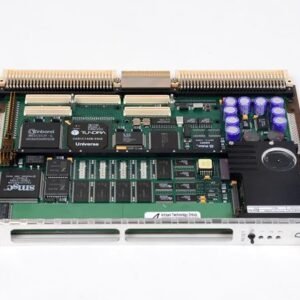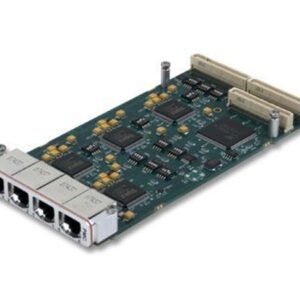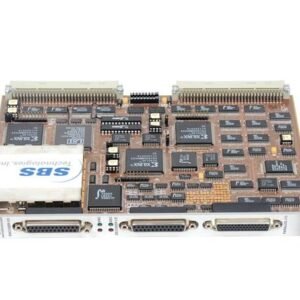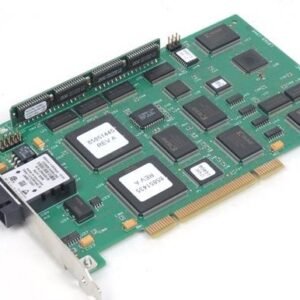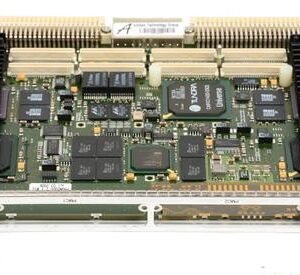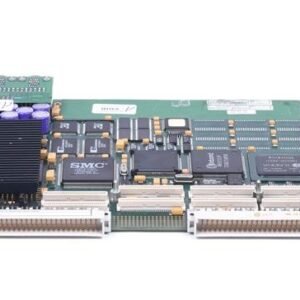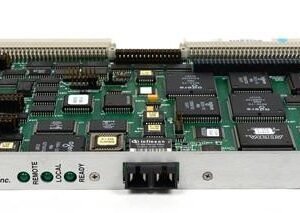
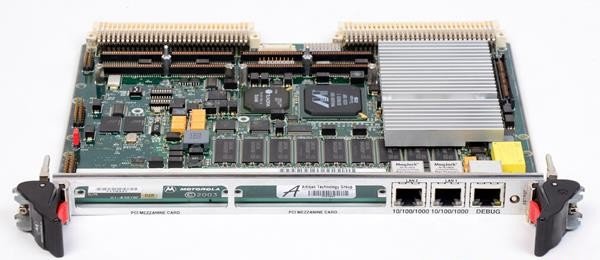

The Emerson/Motorola MVME6100 is a VME single-board computer built on the PowerPC MPC7457 processor running at 1.267 GHz, designed for industrial, defense, and aerospace applications requiring real-time control, data acquisition, and communication. It delivers a practical VMEbus bandwidth of 320 MB/s via the Tundra Tsi148 interface chip and supports migration from legacy MVME systems while providing contemporary processing and I/O capabilities.
## Technical Specifications
**Processor & Memory**
• PowerPC MPC7457 CPU, 64-bit G4 architecture, 1.267 GHz clock speed
• 128-bit AltiVec coprocessor for parallel processing
• L1 cache: 32 KB instruction, 32 KB data; L2 cache: 512 KB; L3 cache: 2 MB
• DDR266 ECC RAM up to 2 GB; 128 MB on-board Flash memory (two 64 MB banks); 32 KB NVRAM with replaceable battery
**VMEbus & Expansion**
• 2eSST VMEbus protocol with 320 MB/s practical bandwidth
• Two 64-bit PCI-X buses operating at 100/133 MHz
• Two PMC-X sites supporting 33/66/100 MHz; supports up to 4 additional PMC sites via PMCspan carriers
• Downward compatible with MVME2300, MVME2400, MVME2600, MVME2700, MVME5100, and MVME5500
**Connectivity**
• Dual Gigabit Ethernet (10/100/1000Base-T)
• Two asynchronous serial ports (RS-232/422/485 via SIMs)
• 8-bit or 16-bit SCSI support via P2 adapter configuration
• USB 2.0 ports (x2)
**System Control & Firmware**
• Marvell MV64360/Discovery II system controller
• MOTLoad on-board monitor/debugger with self-testing
• Operating system support: VxWorks, QNX, Linux, LynxOS
## Key Features
• Jumper-configurable P2 I/O modes: PMC (backward compatible with MVME2300/2400 and MVME5100/5500) and IPMC (legacy MVME761/MVME712M module support)
• 133 MHz DDR memory bus
• Flexible serial port configuration via SIMs
## Typical Applications
Real-time embedded systems, industrial control platforms, aerospace data processing, defense communications infrastructure, and legacy VME system upgrades.
## Compatibility & Integration
The MVME6100 maintains backward compatibility with existing VMEbus architectures while supporting modern PMC-X expansion and dual Gigabit Ethernet for network-centric deployments. IPMC mode enables integration of legacy I/O modules for systems requiring UW-SCSI, parallel, and extended serial connectivity.