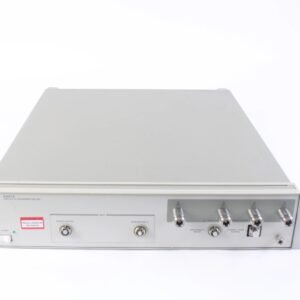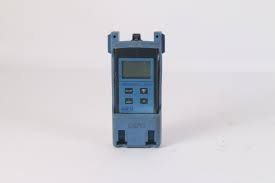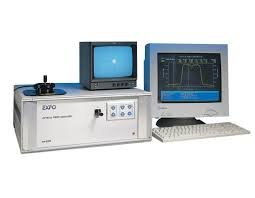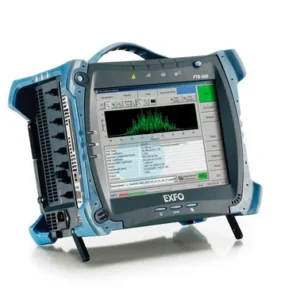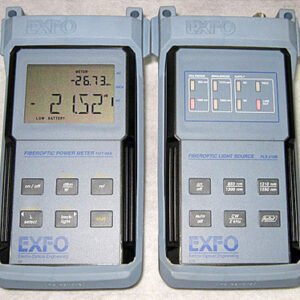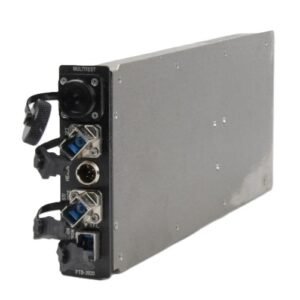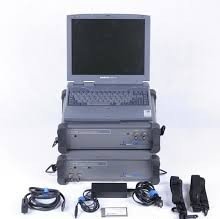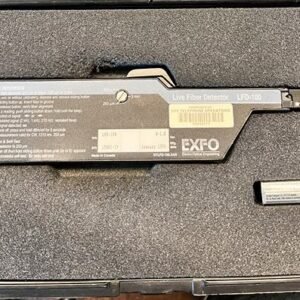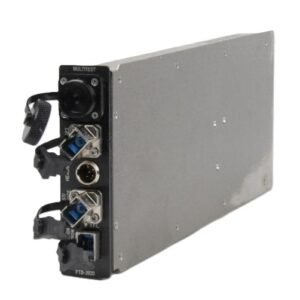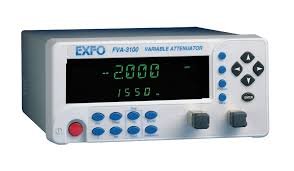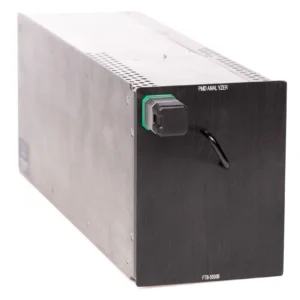

The Exfo FPMD-5600 Femtosecond PMD Analyzer is a precision instrument for measuring polarization mode dispersion (PMD) in optical fiber systems. It employs femtosecond laser technology and Fourier-transform-based Interferometric (FPI) analysis—mathematically equivalent to Jones Matrix Eigenanalysis and approved by ITU, IEC, and TIA standards—to characterize PMD down to the femtosecond range. Essential for high-speed optical networks (10, 40, and 100 Gbit/s), the analyzer measures all Stokes parameters (s0, s1, s2, s3) and differential group delay as a function of wavelength or frequency. Its design minimizes environmental sensitivity to stress and temperature variations, delivering unbiased results even in production floor environments.
## Technical Specifications
• **PMD Measurement Range:** Down to femtosecond range
• **Stokes Parameters:** Complete characterization of s0, s1, s2, s3
• **Wavelength Range (Standard Calibration):** 1530 nm to 1600 nm; custom ranges available
• **Spectral Resolution:** 0.03 nm over C+L-band
• **DUT Gain/Attenuation Support:** +25 dB gain to −45 dB attenuation
• **Measurement Accuracy:** <0.5% variation (verified against NIST standard, 372 fs PMD artifact)
## Key Features
• Broadband non-polarized ASE source integrated
• Polarization synthesizer (0°, 45°, 90°) for complete state generation
• Fourier transform spectrum analyzer with dedicated polarimeter
• FPI technique based on Poincaré Sphere Analysis
• Plug-and-measure routine for rapid deployment
• Customizable user profiles
• Handles composite systems with gain, attenuation, and filtering
## Typical Applications
• High-speed optical network characterization and validation
• Fiber manufacturing quality control and process optimization
• PMD artefact and standard verification
• Polarization state analysis across C+L-band wavelengths
## Compatibility & Integration
Fully compatible with ITU, IEC, and TIA standard measurement methodologies. Accepts Devices Under Test with integrated ASE source coupling. Standard operation within 1530–1600 nm; measurement outside calibration range may produce erroneous results.