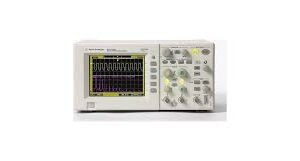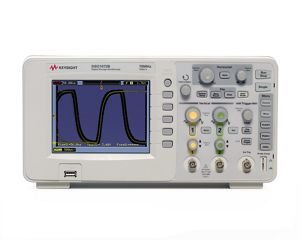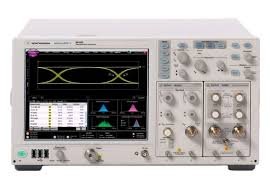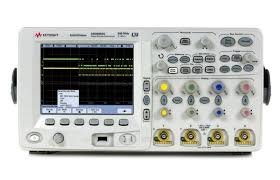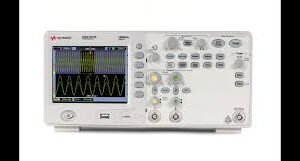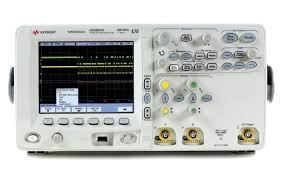
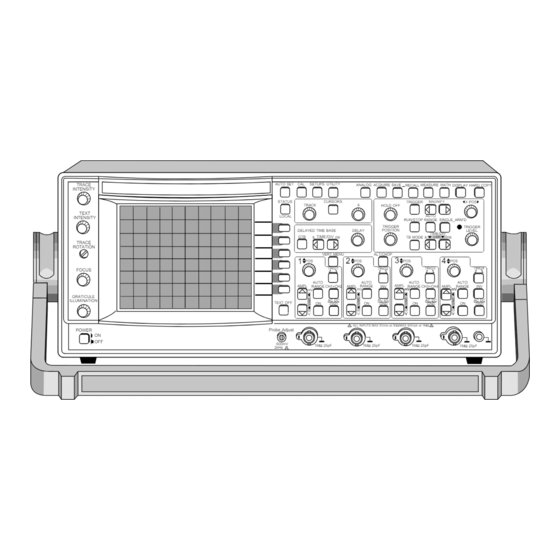

The Fluke PM 3370B is a 60 MHz, 2-channel benchtop oscilloscope combining analog real-time and digital storage acquisition modes. This dual-mode architecture enables operators to select between analog display for complex or modulated signals and digital storage for single events, low-frequency analysis, and automated measurements. The instrument delivers up to 200 MS/s single-shot sampling with 10 GS/s equivalent sampling on repetitive signals, paired with user-partitioned acquisition memory supporting up to 32K long records or over 200 traces of 512 points each.
Technical Specifications
• Bandwidth: 60 MHz
• Analog channels: 2
• Form factor: Benchtop
• Single-shot sample rate: 200 MS/s
• Equivalent sampling rate (repetitive): Up to 10 GS/s
• Memory depth (maximum): 0.032 Mpts
• Standard memory: 8K (2-channel), expandable to 32K
• Vertical display resolution: Infinite (analog mode)
– Key Features
• Triggering modes: Auto free run, Triggered, Single; Edge, TV (including HDTV and line selection), Glitch (20 ns minimum), Pattern, State, and 2 ns Glitch triggering on 2-channel models
• Peak detection: Captures glitches as narrow as 5 ns
• Delayed time base with pre-trigger recording and event delay in both analog and digital modes
• Automatic measurements: Vp-p, Vrms, Vmax, Vmin, frequency, period, rise time, overshoot
• Time and voltage readout: dV, V1–ground, V2–ground, dT, 1/dT, phase, and ratio functions
• Touch, Hold and Measure: Instant Vdc, Vp-p, Vrms, and frequency via probe command
• Signal processing (standard): Add, Subtract, Multiply, Digital filter
• Signal processing (Math+ option): Integrate, Differentiate, FFT, Histogram
• X vs. Y mode for modulation analysis and phase displays
• Multiple Single Shot mode (Math+ option): Stores up to 200 consecutive single-shot events
• Limit testing (Math+ option): Pass/fail based on measurement parameters or waveform comparison
• Reference templates: Created on-screen, stored, protected, and downloadable via AnyWave V2.0 software
– Interfaces and Connectivity
• RS-232C serial interface (standard)
– Typical Applications
Complex signal analysis, modulation characterization, transient capture, low-frequency measurement automation, and ATE pass/fail validation.