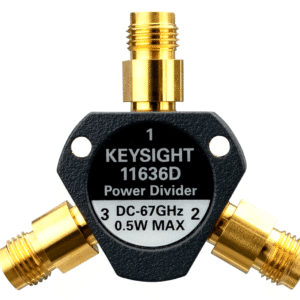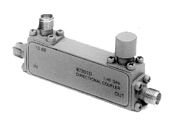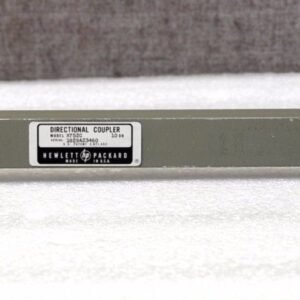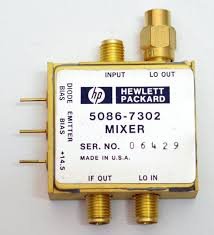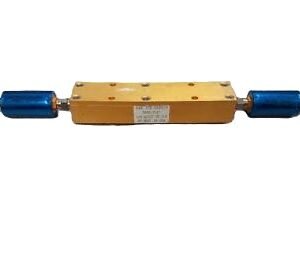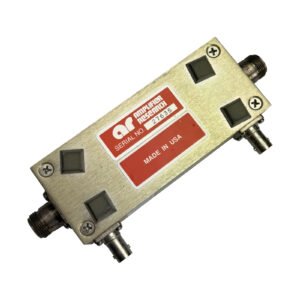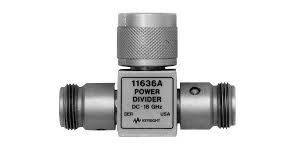

The HP/Agilent 11636A is a precision 50 Ω power divider operating from DC to 18 GHz. It splits RF signals into two equal-amplitude, phase-coherent paths with symmetrical 6 dB division, making it suitable for calibration, network analysis, and broadband signal sampling in test systems. The device delivers exceptional output port symmetry and maintains stable attenuation across its frequency range with minimal temperature and power coefficient drift. No tuning or adjustments are required, and it functions equally well as a power combiner.
Technical Specifications
• Frequency Range: DC to 18 GHz
• Attenuation: Symmetrical 6 dB division; 6.0 dB typical insertion loss
• Insertion Loss Flatness: −0.2 dB, +1.2 dB maximum to 10.0 GHz; +1.5 dB maximum to 18.0 GHz (calibrated at DC, 6.0, 12.0, and 18.0 GHz)
• Amplitude Tracking: Maximum 0.5 dB between output ports
• Phase Tracking: 2 degrees typical
• VSWR (All Ports): Maximum 1.35
• Isolation: High isolation between outputs
• Maximum Input Power: 1.0 W CW; 1 kW peak (5 msec pulse width)
• Internal Resistance: 33.3 Ω ±2 Ω (output to input center conductor)
• Connectors: Two N(f), one N(m) with injection-molded interface insulators
• Weight: 2 lb
– Key Features
• Excellent output power symmetry and phase coherence between ports
• Low temperature and power coefficients ensure attenuation stability
• Superior source match across all three ports reduces reflections in measurement systems
• Bidirectional operation—functions as power combiner without performance degradation
• Passive design requires no electrical tuning or mechanical adjustment
– Typical Applications
• Network and scalar network analyzer measurements
• Transmission line fault location testing
• RF power calibration and comparison measurements
• Broadband independent signal sampling in test architectures
• Single-source splitting for dual-channel or multi-antenna systems
• Low-power signal distribution to multiple antenna feeds
– Compatibility & Integration
Standard 50 Ω N-type connectors ensure compatibility with most RF laboratory instruments. Stable connector interface dimensions support reliable repeated mating without performance degradation.