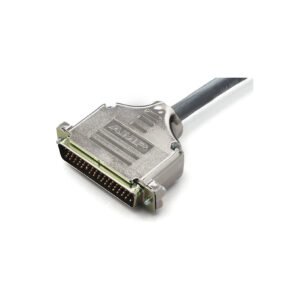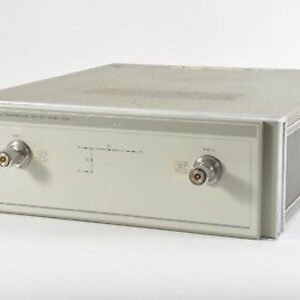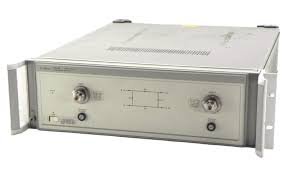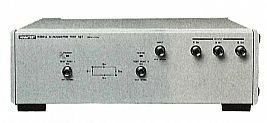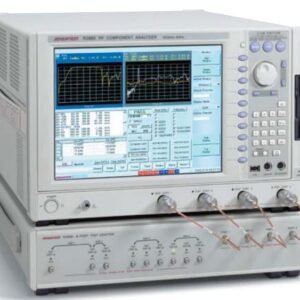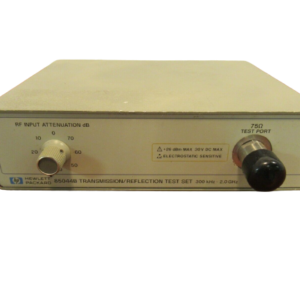

The IFR Aeroflex SDX2000 is a fully programmable RF test set for complete validation of commercial and military L-Band avionics. It integrates ATCRBS and Mode-S transponder testing, DME, TACAN, and IFF simulation into a single platform, meeting or exceeding U.S. Military requirements for safety and environmental performance. Designed for development, manufacturing, field service, and maintenance of airborne electronic systems.
Technical Specifications
• Frequency Range: 960 MHz to 1215 MHz
• RF Output Power: 0 dBm to 30 dBm (±0.5 dB accuracy)
• Transponder Receiver Sensitivity: -74 dBm
• Interrogator Receiver Sensitivity: -85 dBm
– Key Features
Pulse Transmitter Control
• Programmable pulse width: 10 ns to 999.9 µs
• Programmable pulse spacing: 10 ns to 999.9 µs
• Pulse repetition frequency (PRF): 1 Hz to 20 kHz
• Modulation types: AM, FM, PM, Pulse
DME Simulation
• Ground station mode with programmable range delay (-1 to 400 nmi in 0.01 nmi steps)
• Velocity simulation: 0 to 10,000 KTS (1 KT steps)
• Acceleration simulation: 0 to 400 ft/s/s (1 ft/s/s steps)
• Channel spacing: 50 kHz and 100 kHz options
• Frequency accuracy: ±50 kHz
IFF & TACAN Testing
• Mark X and Mark XII mode simulation
• Mode 4 testing with/without KIT, KIR, or KIV
• Two independent RF channels for diversity and sum/difference testing
• Air-to-air, air-to-ground, and inverse TACAN modes
• Bearing simulation rate: up to 39°/s
• Modulation adjustable for 15 and 135 Hz
Data Link & Mode-S
• All Uplink/Downlink protocols supported
• Extended Squitter testing
• Comm-A, Comm-B, Comm-C, Comm-D, and Extended Length Message (ELM) support
Interface & Control
• Color LCD touch-screen display (active matrix)
• Full GPIB programmability for ATE integration
• Integral solid-state disk drive for test sequence storage
• Intuitive menu-driven interface with pop-up controls
– Compatibility & Integration
Supports all ATCRBS modes (A, B, C, D, 1, 2, T, A/C), Mode-S transponders with complete data link capability, DME, TACAN, and all SIF IFF modes. Two independent RF channels enable diversity testing and simultaneous sum/difference measurement.