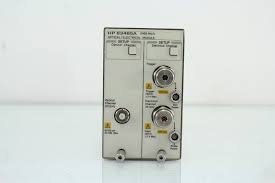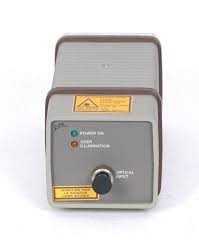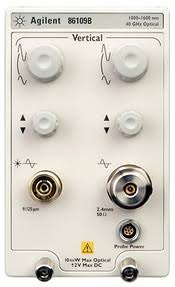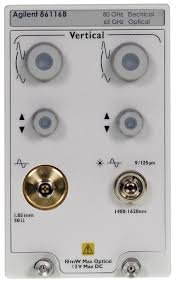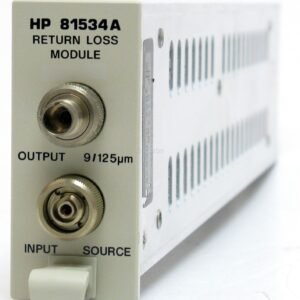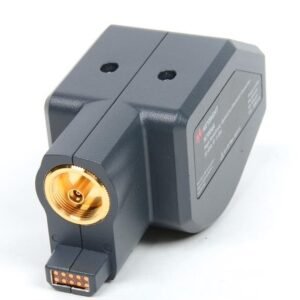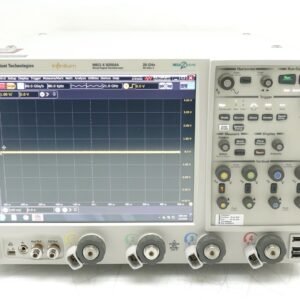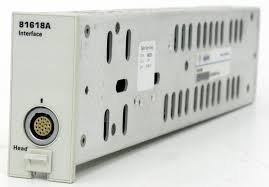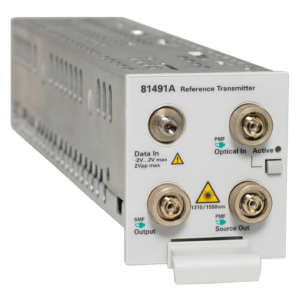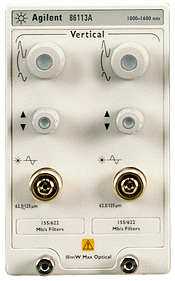
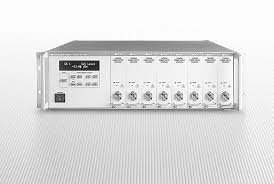

The ILX Lightwave FOM-7900B is a multi-channel source mainframe for precise control and characterization of laser diodes and optical sources across research, development, and manufacturing workflows. The modular platform accommodates up to eight plug-in modules—including laser sources, power meters, and fiber optic switches—with scalability to 200 channels via cascaded mainframes controlled from a single GPIB address. Ideal for WDM, CWDM, EDFA, SOA characterization, and general fiber optic component testing.
## Technical Specifications
**Mainframe Architecture**
• Up to 8 plug-in module slots per mainframe
• Cascadable up to 25 additional FOM-7900B units for 200 total channels
• Single GPIB control address for all linked systems
**Laser Source Modules (FOS-79800 Series)**
• Wavelengths: 1475–1625 nm user-specified; service channels at 1310, 1480, 1510, 1625 nm; DFB coverage of S, C, and L-bands
• Tuning range: 1.7 nm per channel with 0.001 nm resolution
• Output power: Up to 20 mW per channel (10 mW and 20 mW options available)
• Wavelength stability: ±3 pm standard; FOS-79800F series ±25 pm (90 days post-calibration), ±50 pm (one year)
• Power stability: ±0.003 dB typical (±0.003 dB over 15 minutes)
• Linewidth control: Coherence tuning from 30 MHz to 1 GHz
• Custom fiber connector types, PM alignment, and ITU grid center wavelengths available
**Fiber Optic Switch Modules (FOS-79710)**
• 1×4 configuration; optically passive and bi-directional
• Switching modes: timed, random, sequential, or triggered
• Format and bandwidth transparent
**Dual Power Meter Modules (DPM-79810)**
• Dual-channel optical power measurement
**Internal Modulation**
• Frequency range: 0.1–500 kHz; 1–500 kHz
• Waveform: TTL square wave
• Duty cycle: 50% ±1%
• Modulation depth: 100%
• Rise/fall time: <2 (units as specified in source)
## Key Features
• High-resolution wavelength tuning with 0.001 nm steps
• Tight wavelength stability suited to multi-channel coherent testing
• Modular architecture scales from 8 to 200 synchronized channels
• Passive switching for format-agnostic signal routing
• Synchronous modulation to 500 kHz for dynamic characterization
## Typical Applications
• WDM and CWDM system validation
• EDFA and SOA gain characterization
• Sequential multi-wavelength device testing
• Reference signal routing via passive switching
• High-channel-count optical source integration
## Compatibility & Integration
• GPIB interface for centralized control across cascaded systems
• Plug-in module architecture supports mixed source, switch, and meter configurations
• Customizable wavelength, fiber connector, and PM fiber options to match laboratory requirements