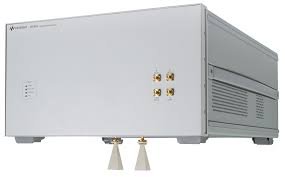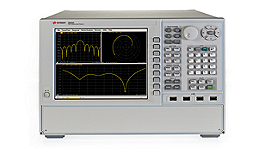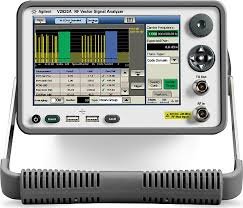
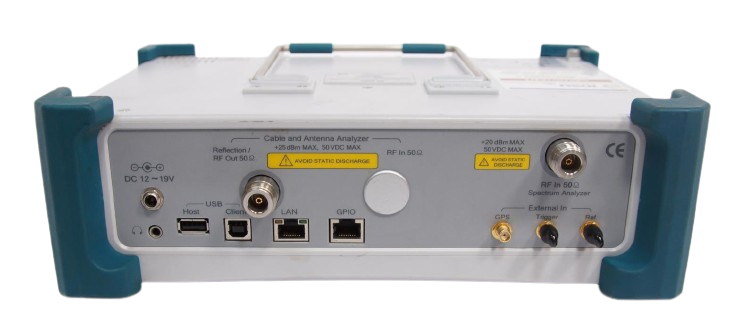

The JDSU JD746A CellAdvisor is a portable RF analyzer engineered for cell site installation, maintenance, and physical layer troubleshooting of cellular networks. This field instrument combines spectrum analysis, cable and antenna characterization, and power measurements into a single platform. It delivers one-button measurements across common BTS performance metrics while enabling detailed signal quality verification, interference identification, and antenna system validation. Field-ready design includes a backlit keypad for low-light operation and a rugged enclosure rated for harsh deployment environments.
Technical Specifications
Spectrum Analysis (100 kHz to 4 GHz)
• Sensitivity: –155 dBm (with preamplifier)
• Phase noise: –90 dBc/Hz at 30 kHz offset (typical)
• Measurement range: DANL to +20 dBm or DANL to +30 dBm
• Input attenuator: 0 to 50 dB in 5 dB steps
• Maximum average input: +20 dBm continuous
• DC voltage withstand: ±50 V
• Frequency span: 0 Hz (zero span) to 4 GHz
• Resolution bandwidth: 1 Hz to 3 MHz (1-3-10 sequence, ±10% nominal)
• Video bandwidth: 1 Hz to 3 MHz (1-3-10 sequence, ±10% nominal)
• Detectors: Normal, positive peak, sample, negative peak, RMS
• Traces: 6 with clear/write functions
• Real-time frequency analysis with digital signal processing
Cable and Antenna Analysis (5 MHz to 4 GHz)
• Measurement speed: 1.65 ms/point (nominal)
• Data points: 126, 251, 501, 1001 selectable
• VSWR range: 1 to 65 (0.01 resolution)
• Return loss: 0 to 60 dB (0.01 dB resolution)
• Distance to fault: Up to 1500 m with 0.01 resolution
• Cable loss (1 port): 0 to 30 dB (0.01 dB resolution)
• Phase (1 port): –180° to +180° (0.01° resolution)
• Smith chart resolution: 0.01
• Directivity: 40 dB (typical)
– Key Features
• Zero span with gate sweep for pulse and burst signal triggering (WiMAX, GSM, TD-SCDMA)
• Standard measurements: Channel power, occupied bandwidth, spectrum emission mask, adjacent channel power, spurious emissions, field strength, AM/FM audio demodulation
• Selectable data point density for cable characterization trade-offs
• Six independent trace storage and overlay capability
– Typical Applications
• BTS antenna system commissioning and validation
• Cable and feed network characterization and fault location
• Interference detection and spectral occupancy mapping
• Cellular signal quality assessment during installation and maintenance
• Transmission line integrity verification at extended distances
– Compatibility & Integration
Designed specifically for field technicians performing cell site physical layer diagnostics across 2G, 3G, and 4G network architectures.