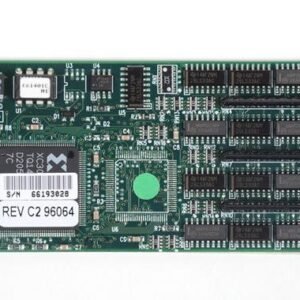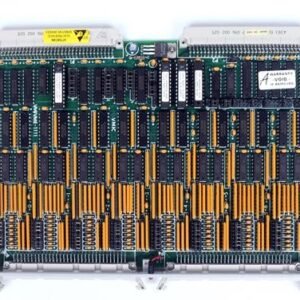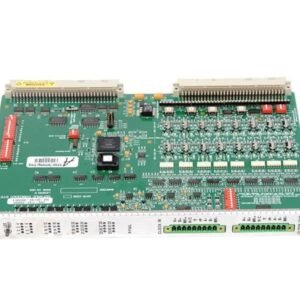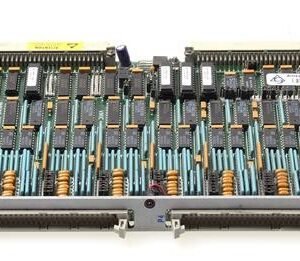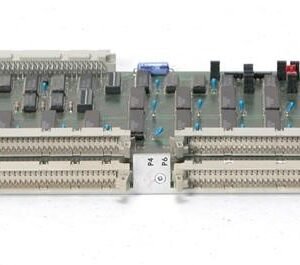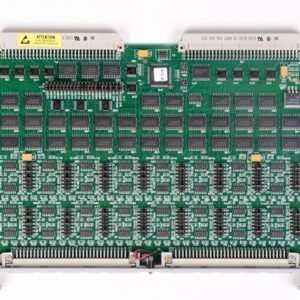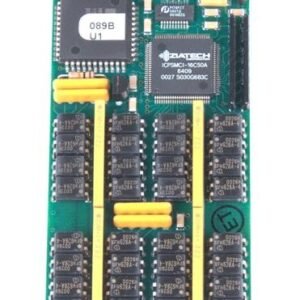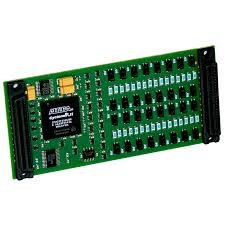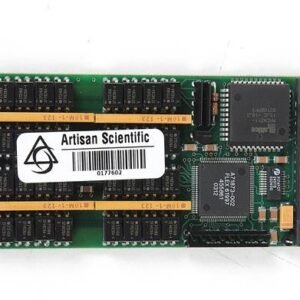
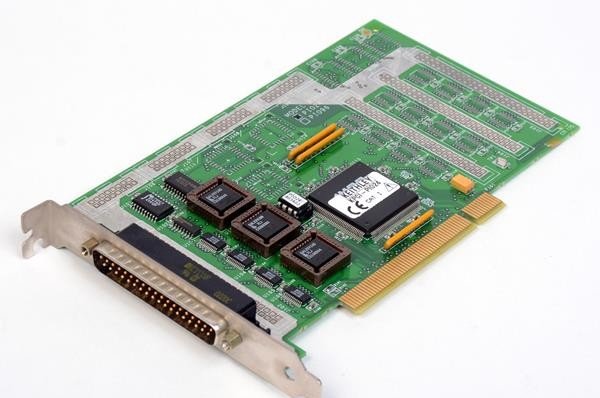

The Keithley KPCI-PIO24 is a 32-bit PCI-bus digital I/O module that provides 24 TTL-level parallel I/O lines for industrial automation, data acquisition, and process control applications. The module organizes its I/O capability into three independent 8-bit ports (PA, PB, and PC), each independently configurable as input or output under software control. Port PC can be further subdivided into two 4-bit half ports for enhanced application flexibility. Built around the AMCC S5933 PCI bus controller, the KPCI-PIO24 supports plug-and-play operation and leverages the PCI bus 32-bit architecture for reliable integration into host systems.
## Technical Specifications
• **Digital I/O:** 24 TTL-level lines organized into three 8-bit ports
• **Port Configuration:** PA, PB, and PC independently configurable as input or output; PC subdivides into two 4-bit half ports
• **Output Drive:** 15 mA source, 64 mA sink
• **Input Voltage Levels:** VIH 2.0 V minimum, VIL 0.8 V maximum
• **Input Current:** ±1 µA maximum (IIH at VIN = 2.7 V)
• **PCI Bus Controller:** AMCC S5933
• **Power Supply Access:** +5V, +12V, −12V, and −5V externally accessible from host PC
• **Operating Temperature:** 0°C to 50°C
• **Storage Temperature:** 0°C to 70°C
• **Humidity:** 0 to 95%, non-condensing
## Key Features
• All ports default to input configuration on power-up or reset
• Port read/write access available regardless of current configuration without affecting external signal levels
• Accessible interrupt configuration for customizable programmed I/O operations
• DriverLINX software API included; supports Visual C/C++, Visual Basic, and Delphi application development
• Complies with EN61010-1/IEC 1010 for Installation Categories I and II per IEC 60664
## Typical Applications
• Industrial automation systems requiring parallel digital I/O
• Data acquisition and process control
• Custom control and monitoring applications
## Compatibility & Integration
The KPCI-PIO24 is compatible with ERB-24, SSIO-24, SRA-01, and ERA-01 accessories. DriverLINX software provides register-free configuration and eliminates the need for low-level register programming.