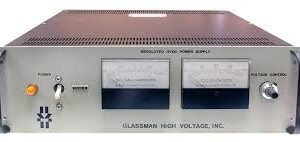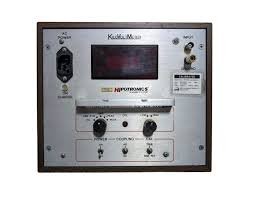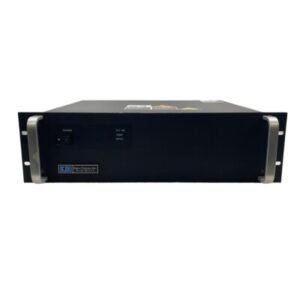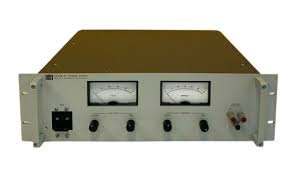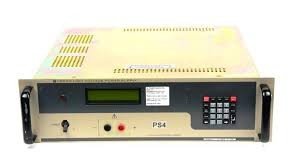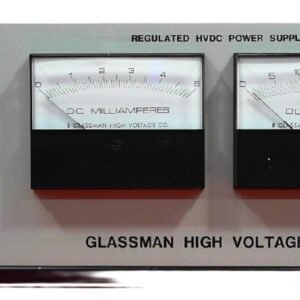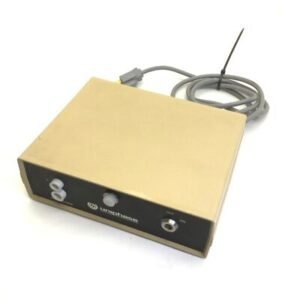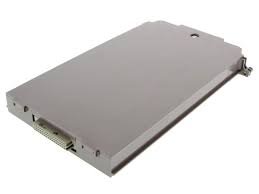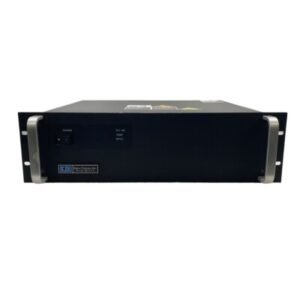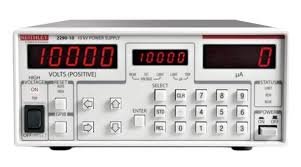
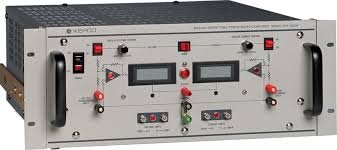

The Kepco BOP-500M is a high-voltage bipolar operational power supply and amplifier delivering ±500 V and ±80 mA across all four quadrants. It sources and sinks current without polarity switching, enabling bidirectional power flow in demanding precision applications. With 40 W total output capacity, the unit combines low output impedance (0.05 Ω DC resistance in voltage mode) and exceptional stability—load effect under 0.0005% in voltage mode, temperature coefficient below 0.01% per °C, and 8-hour drift less than 0.01% of setting.
## Technical Specifications
**Output Ranges**
• Voltage: −500 V to +500 V
• Current: −80 mA to +80 mA
• Total Power: 40 W
**Output Impedance (Voltage Mode)**
• DC Resistance: 0.05 Ω
• Series Inductance: 5 mH
**Output Impedance (Current Mode)**
• Shunt Resistance: 100 MΩ
• Shunt Capacitance: 0.3 µF
**Control Channels**
• Voltage Control Gain: 50 V/V, 150 kHz bandwidth
• Current Control Gain: 8.0 mA/V, 2 kHz bandwidth
**Stability & Performance**
• Load Effect (Voltage Mode): <0.0005% of setting
• Load Effect (Current Mode): <0.005% of setting
• Source Effect: <0.0005% of setting (both modes)
• Temperature Coefficient: <0.01% per °C (both modes)
• 8-Hour Drift: <0.01% of setting (both modes)
• Voltage Mode Noise (RMS): <10 mV
• Voltage Mode Ripple & Noise (20 Hz–10 MHz): <200 mV p-p
• Current Mode Noise (RMS): <25 µA
• Current Mode Ripple & Noise (20 Hz–10 MHz): <500 µA p-p
**Preamplifier Offsets**
• Voltage Mode: <5 µV
• Current Mode: <1 nA
**Reference Accuracy**
• Both modes: <0.0005%
**Environmental**
• Operating Temperature: −20°C to +65°C
• Storage Temperature: −40°C to +85°C
• Cooling: Natural convection
**Power**
• Input: 105–125 V AC or 210–250 V AC, selectable; 50–65 Hz
• Consumption: Approximately 250 W
• Power Factor: 0.8
**Isolation**
• Output and programming terminals: Floating, no DC connection to chassis
• Common terminal: Operates up to 500 V (DC or peak AC) off ground
• Common mode leakage: <50 µA (rms) or <5 mA (p-p) at 115 V AC, 60 Hz
## Key Features
• Four-quadrant operation: source and sink across full voltage and current range
• Dual control channels support independent local or remote programming
• Analog and resistance-based remote programming
• Floating output with high ground isolation
• Ultra-low offset and exceptional load regulation
## Typical Applications
Precision signal conditioning, transducer excitation, servo control loops, and closed-loop test systems requiring bidirectional power amplification and stable DC bias.
## Compatibility & Integration
Analog control inputs accept voltage or resistance signals. Two independent channels enable simultaneous voltage and current command via front-panel or remote terminals.