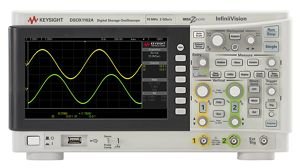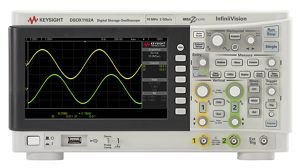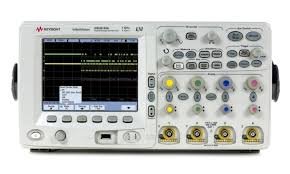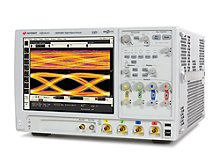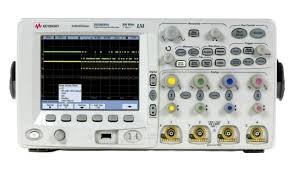
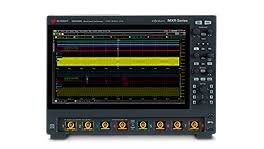

The Keysight MXR408A Infiniium Oscilloscope is an 8-channel, 4 GHz real-time oscilloscope engineered for complex signal analysis and high-speed digital characterization. Built on hardware acceleration ASICs derived from the Infiniium UXR-Series, it delivers waveform update rates exceeding 200,000 wfm/s with exceptional signal integrity. The instrument combines deep acquisition memory, flexible three-stage triggering, and an 8-in-1 integrated measurement platform—oscilloscope, logic analyzer, protocol analyzer, DVM, counter, real-time spectrum analyzer, Bode plotter, and waveform generator. Full bandwidth and channel upgradability protects long-term measurement investments.
Technical Specifications
Analog Channels: 8 (expandable with optional 16 dedicated digital channels)
Bandwidth: 4 GHz, upgradeable to 6 GHz
Sampling: 16 GSa/s on all channels simultaneously
ADC Performance: 10-bit standard, upgradeable to 16-bit high-resolution mode; system ENOB to 9.0; noise floor as low as 43 µV
Memory: 200 Mpts/channel standard, upgradeable to 400 Mpts/channel; flexible combined memory option to 1.6 Gpts
Display: 15.6-inch capacitive touchscreen; Windows 10 operating system
– Key Features
• Hardware-accelerated three-stage triggering with edge, glitch, pulse width, pattern/state, runt, setup/hold, window, OR’d edges, Nth edge, burst, and sequential modes
• InfiniiScan zone and finder triggers for measurement-based acquisition of serial bit streams, runts, and non-monotonic edges
• Segmented memory captures up to 5,205 events post-trigger with no limit between events
• History mode reviews up to 1,024 previous trigger events
• Over 50 standard measurements with protocol analysis for I2C, SPI, RS232, I2S, JTAG, USB2.0, eUSB2, 10/100 ETH, and PCIe 2/1
• Real-time spectrum analyzer with frequency spans to 320 MHz
• Power integrity analysis including PSRR, control loop response, and PMIC characterization
• Jitter and noise statistical analysis with compliance testing and signal integrity software options
– Typical Applications
High-speed digital design validation, power supply characterization, protocol debugging, jitter analysis, and multi-domain signal correlation.