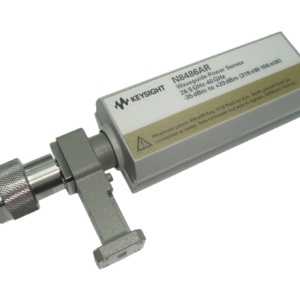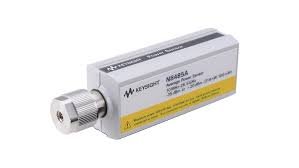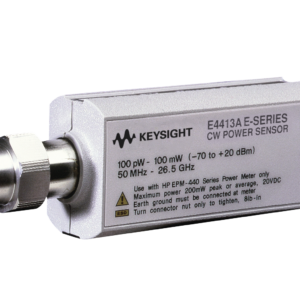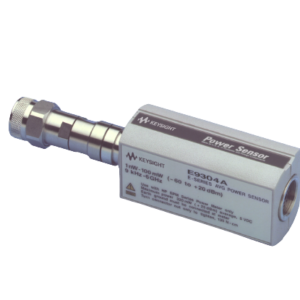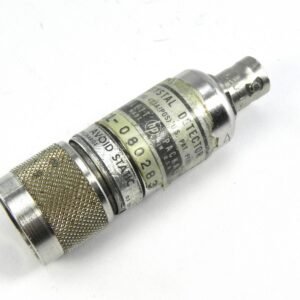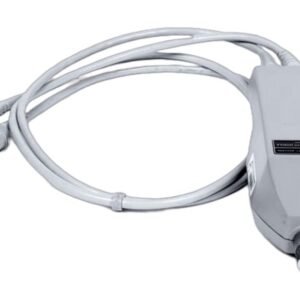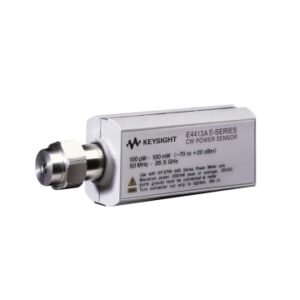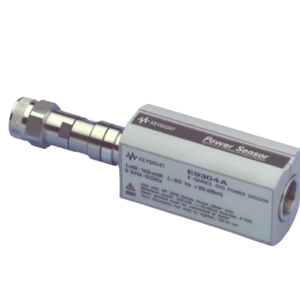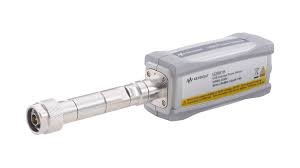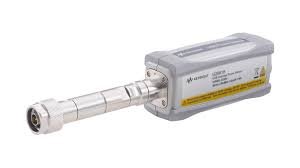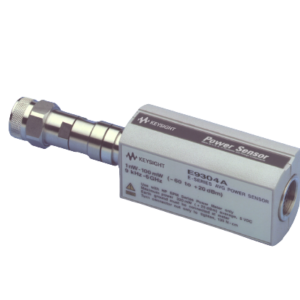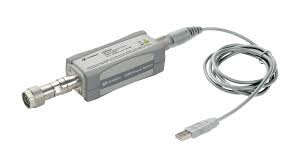
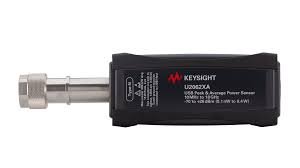

The Keysight U2062XA is a USB power sensor engineered for precise average and peak power measurements spanning 10 MHz to 18 GHz. Operating across a wide dynamic range of -70 dBm to +26 dBm, it delivers high sensitivity and broad power capability for demanding RF and microwave applications. The sensor employs a 4-path diode stack architecture with parallel data acquisition paths, enabling seamless range transitions while maintaining all diodes in their square law region for accurate average power measurement of broadband modulated signals.
Technical Specifications
• Frequency Range: 10 MHz to 18 GHz
• Power Measurement Range (Continuous Average): -70 dBm to +26 dBm (optimal accuracy maintained -45 dBm to +26 dBm for sensors up to 33 GHz with DUT max SWR < 1.2)
• Sampling Rate: Up to 1 MS/s variable; 50,000 readings/sec real-time measurement speed
• Memory: 1M samples data storage
• Sensor Type: Diode (4-path stack configuration)
• Connector: N-type (male)
• Interface: USB with 5 ft (1.5 m) standard cable; optional 10 ft and 16.4 ft extensions available
• Power Supply: USB/LAN port powered; no external supply required
– Key Features
• Real-time Measurement: Zero dead time capture for continuous pulse analysis
• Average Mode Time Selectivity: Configurable aperture duration enabling full dynamic range for average and time-selective average power measurements
• Internal Calibration: Automatic zero and calibration functions reduce measurement uncertainty
• Built-in Signal Presets: DME, GSM, EDGE, WCDMA, WLAN, and LTE configurations for accelerated test setup
• Parallel Data Architecture: 4-path diode stack design provides high accuracy and repeatability across the measurement range
– Typical Applications
• Radar signal characterization
• Wireless communications testing (cellular and WLAN)
• Transient signal analysis
• Pulse power measurement
• Broadband modulated signal assessment
– Compatibility & Integration
The U2062XA integrates with Keysight BenchVue software for streamlined control and data visualization on PC platforms.