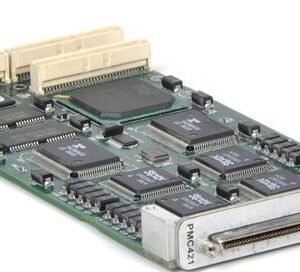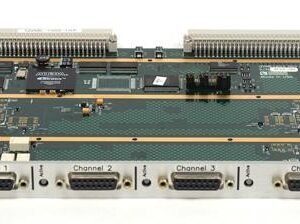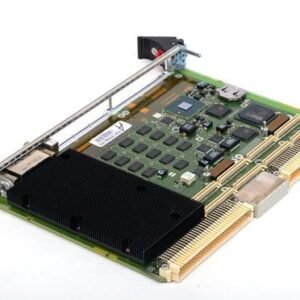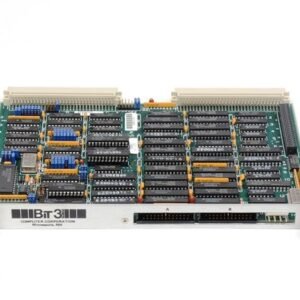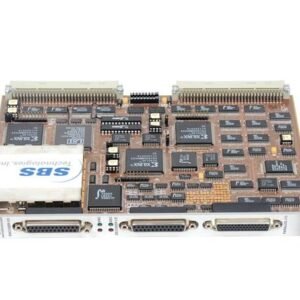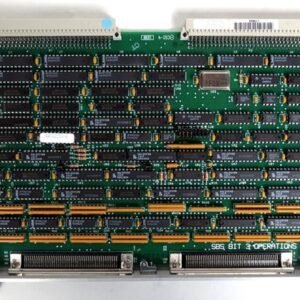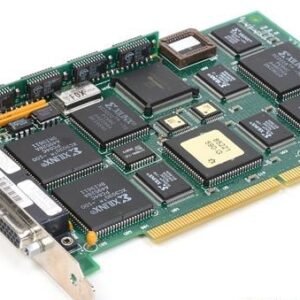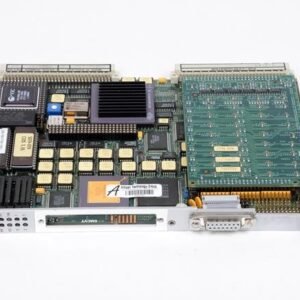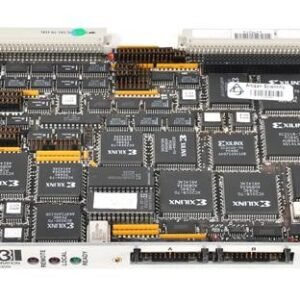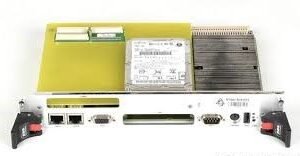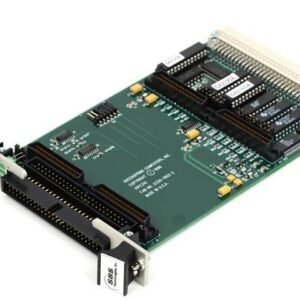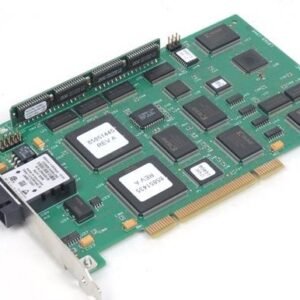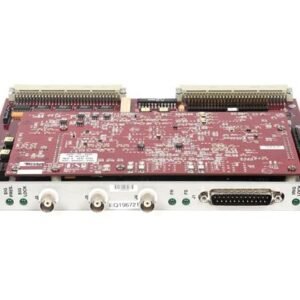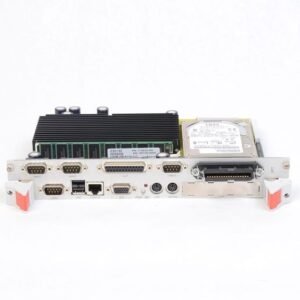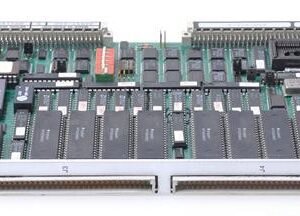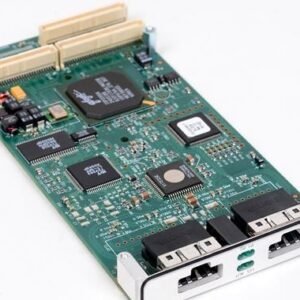
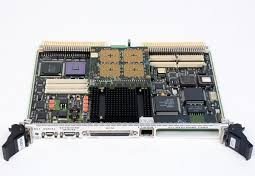

The Kontron / Thales / Cetia VMPC4a PowerEngine 4 is a VMEbus-based single board computer built on a superscalar PowerPC 604e processor operating at 200 MHz and above. Engineered for industrial and military applications demanding sustained performance in moderate shock and vibration environments, it delivers 8.02 SPECint95 and 6.72 SPECfp95 performance metrics at 200 MHz baseline. The architecture combines four instructions per clock cycle, dynamic branch prediction, and multiple integer units with a 64-bit data bus, 32 KB instruction and data caches, and full JTAG compliance.
## Technical Specifications
**Processor Core**
• PowerPC 604e superscalar architecture
• Operating frequency: 200 MHz and above
• Performance: 8.02 SPECint95, 6.72 SPECfp95 (at 200 MHz)
• 32 KB instruction cache, 32 KB data cache
• Four instructions per clock cycle with dynamic branch prediction
• 64-bit data bus with Memory Management Unit (MMU)
• Low Power implementation, fully JTAG compliant
**Memory Subsystem**
• Onboard DRAM: 16 or 32 MB (optional ECC)
• Expandable via IPMD daughter boards: 16, 32, 64, or 128 MB per module (up to 2 modules), optional ECC
• Boot Flash EPROM: 512 KB or 1 MB
• User Flash EPROM: 4 to 32 MB (IPMF module)
• SRAM: 1 MB
**Interfaces & Connectivity**
• Two PCI interfaces (33 MHz, 32/64-bit, up to 50 MHz capable) with master/slave and burst capability
• First PCI internal for Host Bridge, Ethernet, and SCSI2; second supports concurrent operations
• Ethernet: PCnetPCI controller (AM79C970), 10BaseT front panel or Thick on P2, ANSI 802.3 compliant
• SCSI2: SYM53C825A PCISCSI I/O processor, Fast/Wide single-ended support
• Serial: Two RS232C channels with FIFOs (TL16C550C), software compatible with INS8250NB, PC16550A, PC16450
• VMEbus interface, two 16-bit counter/timers, four high-density message FIFOs
• Keyboard/Mouse and non-volatile memory interfaces
## Key Features
• VME double Eurocard form factor (6U × 160 mm)
• CHRP standards-aligned software development environment
• Dual concurrent PCI bus operations via optimized host bridge for potential throughput doubling
• Scalable memory architecture with optional ECC protection across DRAM and daughter boards
## Typical Applications
Military embedded systems, industrial process control, avionics platforms, and mission-critical VME-based instrumentation requiring sustained PowerPC computational performance with extensive I/O versatility.
## Compatibility & Integration
Fully VMEbus compliant with CHRP software alignment. PCI 2.0 standard implementation enables integration with standard PCnet and SCSI2 peripherals. Multi-interface design—Ethernet, SCSI2, dual serial, and general-purpose I/Os—supports heterogeneous embedded systems architectures.