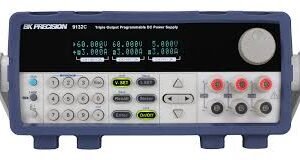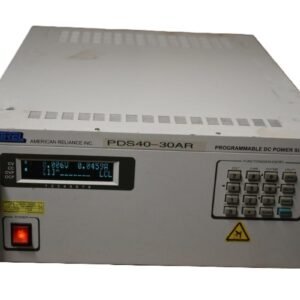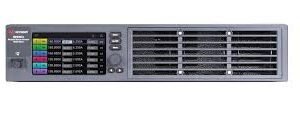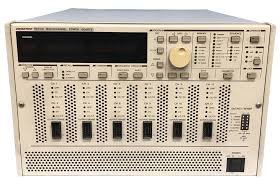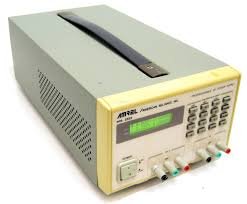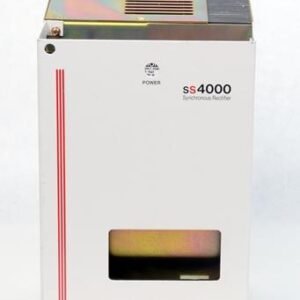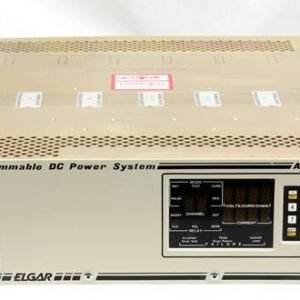
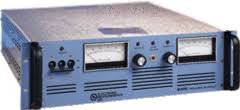

The TDK Lambda EMS80 is a programmable DC power supply engineered for laboratory testing, burn-in applications, and systems integration. Operating in constant voltage or constant current modes with automatic crossover, it delivers adjustable DC output with high efficiency switch-mode conversion. The series supports full analog programming and optional RSTL digital interface control, enabling seamless integration into automated test systems. Forced-air cooling maintains performance across continuous duty cycles in ambient temperatures from 0°C to 70°C, with 1% per degree C derating above 50°C.
## Technical Specifications
• **Output Voltage:** 80 VDC (adjustable)
• **Output Current:** 7.5 A to 30 A (model dependent); up to 185 A in ESS variant
• **Output Power:** 600 W to 2500 W (standard EMS80 models); 14.8 kW (ESS 80-185-7-D-0806)
• **Ripple:** 75 mV (ESS 80-185-7-D-0806)
• **Input Voltage:** 180–250 VAC, 1 or 3 phase; 200–230 V 3 phase; 208 VAC, 400 VAC, 480 VAC (varies by model)
• **Input Frequency:** 47–63 Hz or 50/60 Hz (model dependent)
• **Input Current:** 70 A, 3 phase (ESS 80-185-7-D-0806 example)
• **Operating Temperature:** 0°C to 70°C continuous (with derating above 50°C)
• **Storage Temperature:** -55°C to +85°C
• **Protection:** Overvoltage protection (outputs ≤ 300 VDC), over-temperature protection
• **Cooling:** Forced-air cooling via long-life fans
## Key Features
• Constant voltage/constant current regulation with automatic crossover
• Full analog programmability; optional RSTL digital interface
• High-efficiency switch-mode AC-to-DC conversion
• Digital panel meters (ESS variant)
• Designed for demanding environments with reliable long-term operation
## Typical Applications
• Laboratory bench testing and characterization
• Burn-in and stress testing protocols
• Power system integration and validation
• Automated test equipment (ATE) integration
## Compatibility & Integration
The EMS80 series accepts single and three-phase AC input across multiple voltage standards, supporting global deployment. Analog and optional digital interfaces enable integration with existing control systems and test infrastructure.