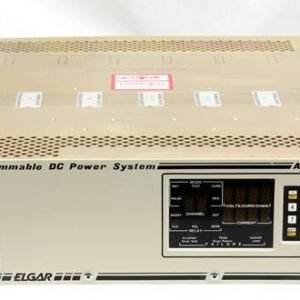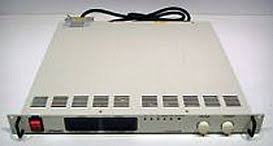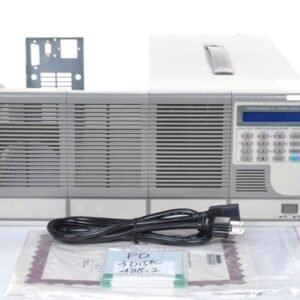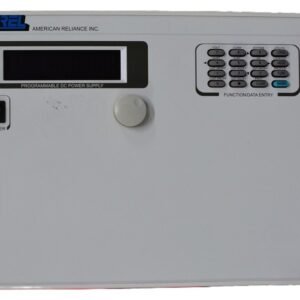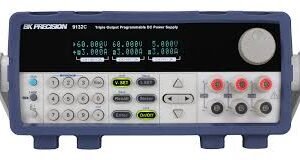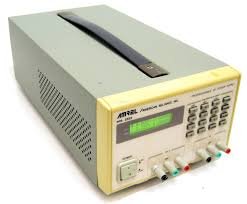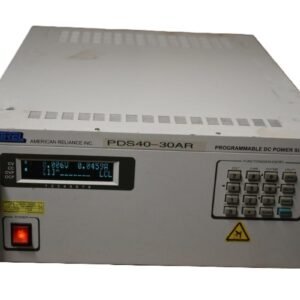
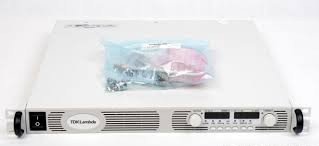

The Lambda / TDK / EMI GEN 40-38 is a 1U rack-mount programmable DC power supply from the Genesys series, delivering 0–40 Vdc at 0–38 A (1520 W maximum). Engineered for industrial, OEM, and laboratory environments, it combines high power density with wide-range single-phase input (85–265 VAC, 47–63 Hz) and Active Power Factor Correction at 0.99 typical for EMC compliance.
## Technical Specifications
• **Output:** 0–40 Vdc / 0–38 A, 1520 W maximum
• **Voltage Ripple Noise:** 0.008 Vrms (5 Hz to 1 MHz)
• **Current Ripple Noise:** 0.095 Arms (5 Hz to 1 MHz)
• **Constant Voltage/Constant Current Auto-Crossover**
• **Line Regulation (CV mode):** Max. 0.01% of Vo + 2 mV
• **Line Regulation (CC mode):** Max. 0.01% of Io + 2 mA
• **Load Regulation (CV mode):** Max. 0.05% of Vo + 5 mV
• **Load Regulation (CC mode):** Max. 0.2% of Io + 10 mA
• **Load Change Response Time (10–90%):** Within 0.5% of rated value
• **Efficiency:** 88% typical
• **Hold-up Time:** >20 ms at 100 Vac, 100% load
• **Input Current:** 21 A / 11 A at 100 / 200 Vac
• **Inrush Current:** <50 A at 100 / 200 Vac
## Key Features
• Adjustable Over Voltage Protection and Under Voltage Limit
• Current Limit Fold Back with Over Current Protection
• Over Temperature Protection
• Built-in RS-232/RS-485 interface with Multi-Drop capability (up to 31 units)
• External analog programming with selectable 0–5 V or 0–10 V ranges
• Remote ON/OFF and Enable/Disable control
• Last Setting Memory with Front Panel Lockout
• Optional GPIB (IEEE 488.2 SCPI), isolated analog, LAN (LXI-compliant), and USB interfaces
• IEC320 input connector (1520 W model uses screw terminal)
## Typical Applications
Industrial test systems, OEM manufacturing, laboratory power sourcing, multi-unit benchtop configurations, and automated test environments requiring precise voltage and current control with remote programmability.
## Compatibility & Integration
RS-232/RS-485 native connectivity supports network control across multiple supplies. Optional interface cards enable GPIB, Ethernet (LXI), and USB integration into existing automated test frameworks.