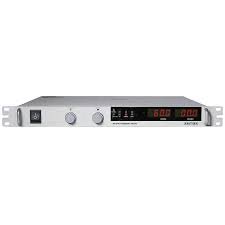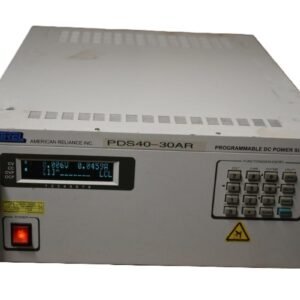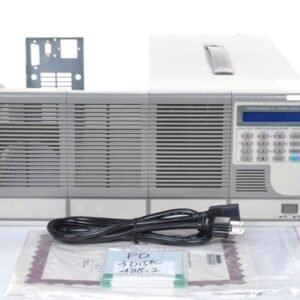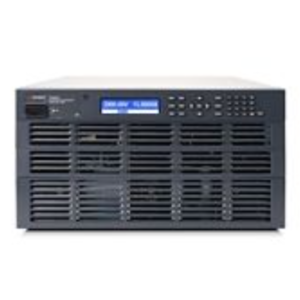
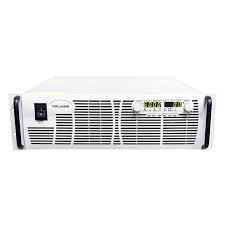

The TDK-Lambda GEN 60-167 is a 10 kW programmable AC/DC power supply delivering 0–60 V DC at 0–167 A for OEM, industrial, and laboratory applications. Built on the Genesys™ platform, this 3U rack-mount or benchtop unit combines active power factor correction (0.99 typical), low output noise, and precise regulation with flexible networking and control interfaces.
## Technical Specifications
**Output:**
• 0–60 V DC, 0–167 A (10 kW total)
• Voltage ripple noise: 0.02 Vrms (5 Hz to 1 MHz)
• Current ripple noise: 0.067 Arms (5 Hz to 1 MHz)
• Efficiency: 83% typical
**Input:**
• 3-phase 480 V: 432–528 Vac
• 3-phase 400 V: 342–440 Vac
• 3-phase 208 V: 180–253 Vac
• Frequency: 47–63 Hz
• Power factor correction: 0.99 (active) or 0.88 (passive, select options)
**Programming & Control:**
• Analog programming: user-selectable 0–5 V or 0–10 V (DIP-switch configurable)
• 16-bit programming and readback accuracy
• Standard interfaces: RS-232, RS-485
• Optional: LAN (LXI compliant), USB, GPIB (IEEE 488), isolated analog
• Opto-isolated remote enable/disable and shut-off
• Front panel: digital encoders with fine/coarse adjustment, local/remote selection, output on/off
## Key Features
• Automatic constant-voltage/constant-current (CV/CC) crossover
• Four-unit parallel operation with master/slave active current sharing
• Remote sensing for load-wire voltage drop compensation
• Adjustable over-voltage protection (OVP), under-voltage limit (UVL), and current foldback
• Non-volatile memory: retains voltage, current, protection setpoints, and mode settings across power cycles
• Safe restart: selectable return to previous settings or zero output after power loss
• Positive, negative, or floating output grounding (±1500 VDC max float)
• Front panel display for live setpoint preview
## Typical Applications
Industrial equipment testing, medical device manufacturing, telecommunications infrastructure, bench-top R&D, and systems requiring high-current low-voltage sourcing with networked control.
## Compatibility & Integration
Dual communication architecture supports RS-232/485 serial control and optional Ethernet (LXI), USB, or GPIB interfaces. Isolated analog inputs and outputs (0–5 V or 0–10 V) enable integration with process controllers and data acquisition systems. Active current sharing enables transparent parallel expansion to 40 kW.