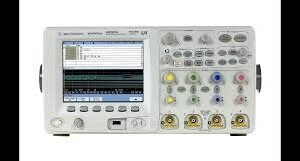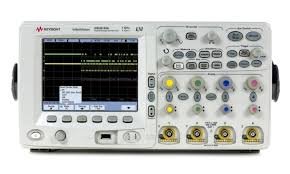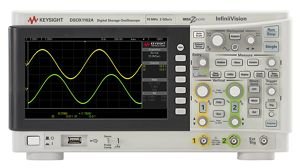

The Teledyne LeCroy LC564A is a 1 GHz, 4-channel digital oscilloscope built for precision waveform acquisition in research, design verification, and field troubleshooting. It delivers single-shot sampling to 4 GS/s and Random Interleaved Sampling (RIS) to 25 GS/s for repetitive signals, with flexible memory allocation up to 500 kpts per channel. The instrument combines advanced trigger capabilities—including glitch detection at 600 ps and SMART trigger modes with exclusion technology—with comprehensive math, spectrum, and parameter analysis functions. An 8-bit vertical system spans 2 mV/div to 1 V/div with ±20 V offset range, DC accuracy of ±(2% full scale + 1% offset), and selectable bandwidth limiting at 25 MHz or 200 MHz. The color 10.4-inch TFT display (640 × 480 pixels) and 96 MHz PowerPC processor enable real-time Analog Persistence mode and simultaneous multi-function processing. GPIB connectivity and onboard storage via floppy disk support integration into automated test environments. Maximum input voltage ratings reach 100 V (1 MΩ) or ±5 VDC (50 Ω), with external trigger capability to 750 MHz.
Technical Specifications
• Bandwidth: 1 GHz
• Channels: 4
• Sample Rate: 4 GS/s single-shot; 25 GS/s RIS (repetitive)
• Acquisition Memory: 250 kpts (2 ch); 100 kpt/ch (4 ch); 500 kpts (1 ch); 400 kPts record length
• Sequence Mode: 2–2000 segments, 1 ns time-stamp resolution
• Vertical Sensitivity: 2 mV/div to 1 V/div, fully variable, 50 Ω
• Vertical Offset: ±20 V (with active probes)
• DC Accuracy: ±(2% full scale + 1% offset)
• Vertical Resolution: 8 bits
• Bandwidth Limiter: 25 MHz, 200 MHz
• Input Coupling: AC, DC, GND
• Input Impedance: 10 MΩ // 11 pF (PP005); 50 Ω ±1.25%
• Max Input Voltage: 100 V (1 MΩ); ±5 VDC (50 Ω)
• Glitch Trigger: 600 ps
• Trigger Frequency: DC to 1 GHz; External 750 MHz (50 Ω)
• External Trigger Range: ±0.5 V; ±2.5 V (Ext/5)
• Processor: 96 MHz PowerPC 603e
• System RAM: 8–64 Mbytes
• Display: Color 10.4-inch TFT LCD, VGA (640 × 480)
– Key Features
• SMART triggers with exclusion technology
• Width, interval, slew rate, and runt trigger modes
• Analog Persistence mode
• Waveform math, spectrum, and parameter analysis
• Four simultaneous processing functions
• Sequence capture with nanosecond precision
• Probe attenuation factors (12 selectable)
– Typical Applications
• Signal integrity and transient analysis
• High-speed digital and analog circuit characterization
• Glitch and fault detection
• Repetitive signal spectrum analysis
– Compatibility & Integration
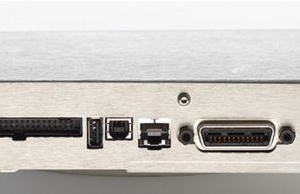
• GPIB (IEEE-488.2) interface
• Floppy disk storage
• 50 Ω and 10 MΩ input paths
• Active probe support (AP020/AP022)