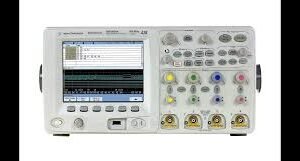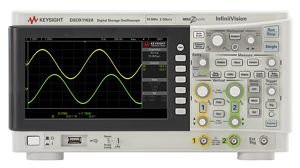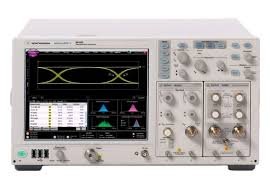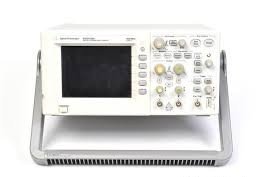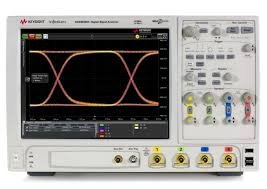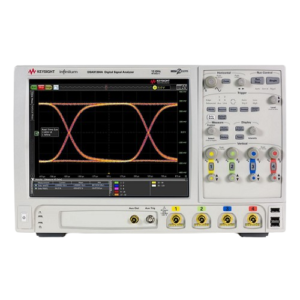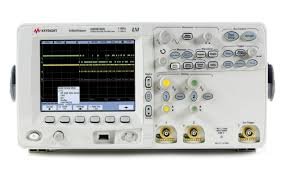

The LeCroy LC584AL is a 1 GHz digital oscilloscope built for high-speed signal capture and detailed waveform analysis across four channels. With a maximum single-channel sampling rate of 8 GS/s and multi-channel operation at 2 GS/s, it delivers accurate characterization of complex electronic signals. The instrument features 8-bit vertical resolution, variable sensitivity from 2 mV/div to 10 V/div, and up to 4 M words of record memory per channel. Advanced triggering modes—including runt, slew rate, exclusion, qualified, and TV triggering—enable capture of intermittent faults and video signals. Time/div settings span 1 ns/div to 1000 s/div with Random Interleaved Sampling for repetitive signals and Sequence Mode for time-stamped event capture. The 9-inch color CRT display (640 × 480 pixels) and four zoom traces support efficient multi-parameter analysis.
Technical Specifications
• Bandwidth: DC to 1 GHz (-3 dB) at 50 Ω; DC to 500 MHz typical at 1 MΩ
• Sampling Rate: 8 GS/s single-channel; 2 GS/s across 4 channels
• Vertical Resolution: 8 bits
• Vertical Sensitivity: 2 mV/div to 10 V/div (1 MΩ); 2 mV/div to 1 V/div (50 Ω)
• Record Length: 4 M words maximum; 2 M words per channel
• Input Impedance: 10 MΩ (≈11 pF) or 50 Ω ±1%
• Timebase: 1 ns/div to 1000 s/div; 500 ps/div at 8 GS/s
• Display: 9-inch color CRT, 640 × 480 pixels
– Key Features
• Runt, slew rate, exclusion, and qualified triggering for fault isolation
• TV triggering up to 1500 lines (PAL, SECAM, NTSC, nonstandard)
• Random Interleaved Sampling for repetitive signals from 200 ps/div to 5 µs/div
• Sequence Mode with time-stamped segmented acquisition
• Four independent zoom traces for parallel signal analysis
• Dual input impedance configuration (10 MΩ and 50 Ω)
– Typical Applications
High-speed digital circuit debug, transient capture, video signal analysis, and characterization of signals requiring extended record lengths and fault-triggered acquisition.
– Compatibility & Integration
Compatible with PP005 passive probes (DC to 350 MHz bandwidth). Input impedance selection supports both high-impedance and 50 Ω terminated measurement environments.