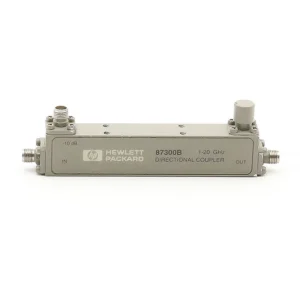
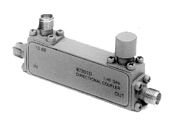
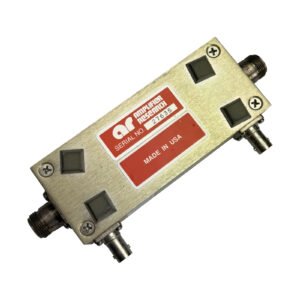
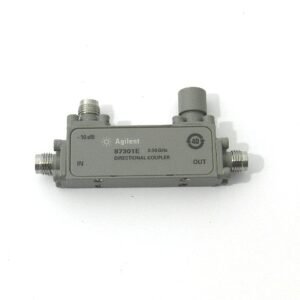
The Narda 4012C is a miniature stripline coaxial directional coupler engineered for precise RF signal sampling and monitoring in the 1.0 to 2.0 GHz band. Available in four coupling values—6 dB, 10 dB, 20 dB, and 30 dB—this series delivers consistent performance across military and general-purpose applications requiring accurate signal division with minimal insertion loss and high directivity.
Technical Specifications
Electrical Performance
• Frequency Range: 1.0 to 2.0 GHz
• Coupling Values: 6 dB, 10 dB, 20 dB, 30 dB (models 4012C-6, 4012C-10, 4012C-20, 4012C-30)
• Coupling Variation: ±1.25 dB (10 dB, 20 dB, 30 dB models)
• Frequency Sensitivity: ±0.75 dB (10 dB, 20 dB, 30 dB models)
• Directivity: 27 dB (4012C-20); 25 dB (4012C-10)
• Insertion Loss: 0.2 dB (20 dB and 30 dB models); 0.9 dB (4012C-10)
• VSWR Primary/Secondary: 1.10:1 (4012C-20 and 4012C-10)
• Average Power: 50 W
• Peak Power: 3 kW (4012C-20)
Physical & Environmental
• Connectors: SMA Female
• Weight: 26 g (4012C-20)
• Operating Temperature: to 105°C
• Storage Temperature: to 125°C
• Construction: Miniature Stripline Coaxial
• Environmental Rating: MIL Environment Rated
– Key Features
• Compact form factor with 26 g mass enables integration into space-constrained systems
• Low insertion loss (0.2 dB typical) minimizes signal degradation on main transmission line
• High directivity specifications ensure accurate coupled-port isolation
• Wide power handling up to 3 kW peak accommodates high-energy RF applications
• Temperature stability from operating to 105°C supports field deployment
• Multiple coupling options provide flexibility for different monitoring requirements
– Typical Applications
• RF signal monitoring and sampling
• Power measurement in microwave systems
• Signal division and distribution networks
• Military and defense RF subsystems
• Test and measurement setups requiring precise signal coupling
– Compatibility & Integration
SMA female connectors provide standard RF interface compatibility. Selection among 6 dB, 10 dB, 20 dB, and 30 dB models allows matching to specific system attenuation and dynamic range requirements within the 1.0 to 2.0 GHz operational band.