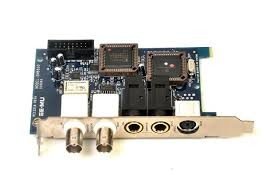

The NI PCI-1588 is a PCI-based synchronization device that implements IEEE 1588-2008 Precision Time Protocol (PTP) for precise clock and event synchronization across networked systems and instruments. Operating as either an IEEE 1588 master or slave clock, the card achieves sub-microsecond synchronization accuracy through an onboard FPGA that automatically adjusts phase and frequency of the internal clock. The device synchronizes with IEEE 1588-compatible instruments and computers via integrated Ethernet, while non-1588 devices connect through three front-panel PFI lines or SMB connectors on the PCI bracket. Additional synchronization with other PCI instruments in the same host machine occurs via the RTSI bus.
The card generates programmable clock signals and events at specified future times and timestamps input events with system time. Output frequencies range from DC to 1 MHz with a minimum pulse width of 36 ns and 50 Ω nominal impedance. The integrated Ethernet port auto-negotiates 10 or 100 Mbps speeds using an AMD PCNET Family PCI Ethernet Adaptor and connects via RJ-45 connector.
Technical Specifications
• Protocol: IEEE 1588-2008 Precision Time Protocol (PTP)
• Synchronization accuracy: Sub-microsecond
• Clock operation: Master or slave mode
• Output frequency range: DC to 1 MHz
• Minimum pulse width: 36 ns
• Output coupling: DC
• Output impedance: 50 Ω nominal
• Programmable function: Duty cycle clock signal generation and event timestamping
– Key Features
• Onboard FPGA for automatic phase and frequency adjustment
• Integrated RJ-45 Ethernet port with auto-negotiation (10/100 Mbps)
• Three PFI connectors for timestamped inputs or future clock outputs
• SMB connectors for non-1588 instrument synchronization
• RTSI bus support for multi-PCI synchronization
• NI-Sync driver software compatible with LabVIEW, LabWindows/CVI, and Visual C/C++
– Power Requirements
• Maximum current: 715 mA
• Typical current: 430 mA
– Typical Applications
Multi-instrument test systems requiring deterministic timing, distributed data acquisition networks, and hybrid environments combining IEEE 1588 devices with legacy instruments.