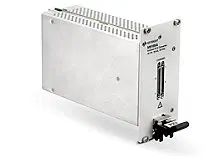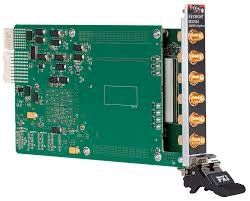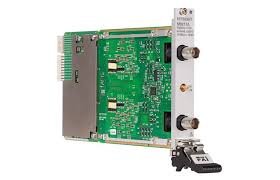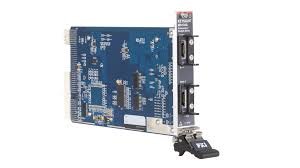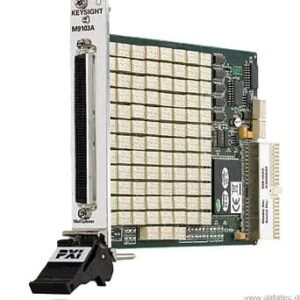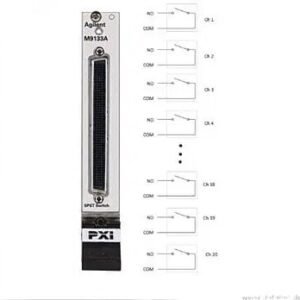

The NI PCIe-8362 is a 2-channel MXI-Express remote controller that enables direct communication between a host PC and external PXI or CompactPCI systems via a single PCI Express x1 slot. This module provides transparent software integration, requiring no additional programming to control connected instruments and devices. It supports sustained throughput of 100 MB/s per channel, with aggregate performance reaching 110 MB/s for single-chassis configurations. The module connects via an 18-pin PCI Express x1 DSUB cable connector and supports copper cabling up to 7 meters in length. Standard cable lengths of 1 m, 3 m, and 7 m are available.
Technical Specifications
• Interface: MXI-Express PCIe x1 Gen1, PCI Express Revision 1.0a compliant
• Number of Channels: 2 MXI-Express ports with star topology
• Throughput: 100 MB/s per channel; 110 MB/s sustained (single chassis); 208 MB/s sustained (dual chassis)
• Host Connector: 18-pin PCI Express x1 DSUB cable connector
• Maximum Cable Length: 7 meters (1 m, 3 m, 7 m standard lengths)
• Dimensions: 9.93 × 7.11 cm (3.91 × 2.8 in.)
• Weight: 0.05 kg (0.12 lb) typical
• Power Supply: +3.3 V @ 580 mA typical, 1.04 mA maximum; +3.3 V AUX @ 10 mA typical, 50 mA maximum
• Operating Temperature: 0 °C to 55 °C
• Storage Temperature: -20 °C to 70 °C
• Operating Humidity: 10% to 90% RH, non-condensing
• Maximum Altitude: 2,000 m
– Key Features
• Software-transparent operation—no additional driver development required
• Compatible with PCI Express x1, x4, x8, and x16 slots
• Supports both PXI and CompactPCI system control
• Connected modules appear as native PCI devices to the host system
• Compact form factor suitable for standard PCIe installations
• Complies with IEC 61010-1 and EN 61010 electrical safety standards
– Compatibility & Integration
Fully compatible with Microsoft Windows and PCI/PCI Express-based PXI controllers. Integrates with MXI-3, MXI-4, and MXI-Express compatible systems. PXI modules controlled through this interface appear directly as PCI devices within the host computer, eliminating the need for custom abstraction layers.