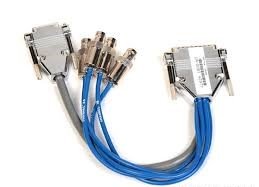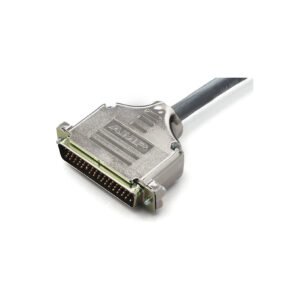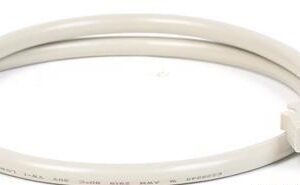

The NI RC68-68 is a 0.50-meter unshielded ribbon cable engineered for direct connection between NI DAQ devices and compatible 68-pin accessory modules. It terminates in a 68-pin VHDCI offset connector on the device end and a 68-pin D-Type SCSI-II female connector on the accessory end, enabling high-current signal transmission across X Series, M Series, and select E Series data acquisition hardware. The flat ribbon construction provides superior space efficiency and airflow optimization compared to traditional bundled cables, while maintaining reliable signal integrity across measurement and control applications.
Technical Specifications
• Cable Type: Unshielded ribbon cable
• Length: 0.50 meters
• Connector A: 68-pin VHDCI offset (0.8 mm pitch)
• Connector B: 68-pin D-Type SCSI-II female
• Part Number: 187252-0R5
• Alternative Designations: R68F-68F, R68-68
• Construction: Flat ribbon with multiple conducting wires on singular plane
• Conductor Material: High-current-rated copper conductor
• Form Factor: Thin, flexible design for routing and storage
• Weight: Lightweight
– Key Features
• High-current handling capability across 68 discrete connections
• Flat ribbon geometry reduces enclosure footprint and improves ventilation
• Offset VHDCI connector design accommodates dense module stacking
• Flexible construction enables tight routing in confined spaces
• Cost-effective connectivity for DAQ signal distribution
– Typical Applications
• Multifunction I/O module interconnection on X Series and M Series DAQ chassis
• Signal routing between simultaneous sampling modules and host devices
• Multiplexed I/O applications requiring high pin-count density
• Compact measurement systems where cable bulk must be minimized
– Compatibility & Integration
Fully compatible with NI 63xx series multiplexed and simultaneous sampling multifunction I/O modules (formerly designated X Series 63xx), NI 62xx M Series hardware, and legacy E Series DAQCard models 6062E and 6024E. The VHDCI offset connector standard ensures mechanical and electrical compatibility across these DAQ device families.