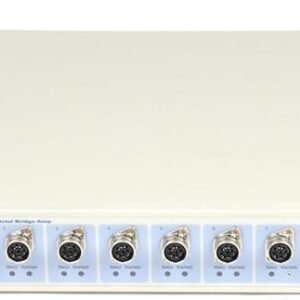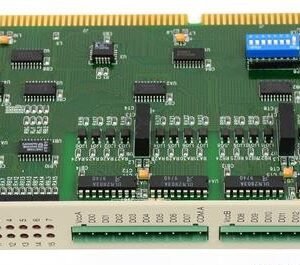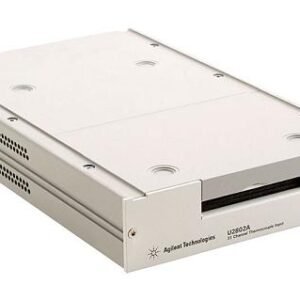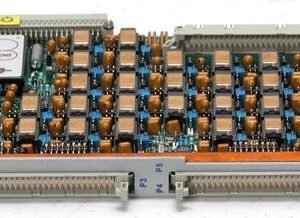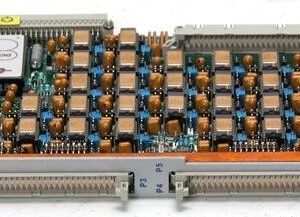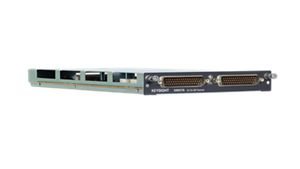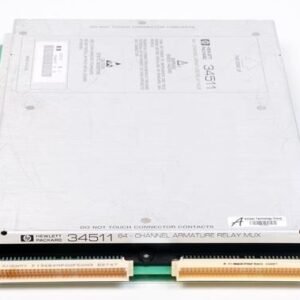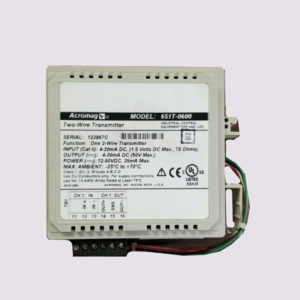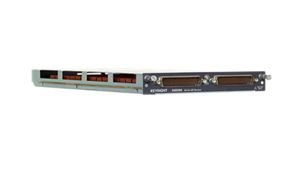

The NI SCXI-1102 is a 32-channel thermocouple amplifier module for high-accuracy temperature measurements within the SCXI signal conditioning platform. It conditions signals from thermocouples (J, K, T, E, R, S, B, N types), millivolt and volt sources, and 4–20 mA or 0–20 mA current sources. When paired with the SCXI-1581 precision current source module, it also measures RTDs and thermistors. The module integrates onboard cold-junction compensation and requires an SCXI chassis for operation.
Technical Specifications
Analog Input Channels
• 32 differential channels with software-configurable gain of 1 or 100
• Input range: ±100 mV or ±10 V per channel (SCXI-1102C: ±10 V maximum working voltage)
• Overvoltage protection to ±42 V
• Sampling rate: up to 333 kS/s maximum
Signal Filtering
• SCXI-1102: Two-pole low-pass filter, 2 Hz cutoff, 60 Hz noise rejection
• SCXI-1102B: Three-pole low-pass filter, 200 Hz cutoff
• SCXI-1102C: Three-pole low-pass filter, 10 kHz cutoff
Cold-Junction Compensation
• Onboard CJC sensor channel; SCXI-1300 terminal block provides additional CJC
• Isothermal terminal blocks like SCXI-1303 recommended for precision measurements
Power Requirements
• SCXI-1102C: 15 mA at 5 V, 150 mA at ±15 V maximum
Physical
• Dimensions: 1.2 × 6.8 × 7.4 inches (3.0 cm × 17.2 cm × 18.8 cm); SCXI-1102C: 1.2 × 6.8 × 8.0 inches
• Weight: 24.6 oz
• Operating temperature: 0 to 50 °C
– Key Features
• Instrumentation amplifier per channel with selectable gain optimization
• Multiple thermocouple type support across product variants
• Multiplexing capability routes all inputs through single DAQ device channel
• Precision isothermal terminal block compatibility for enhanced accuracy
– Typical Applications
• Multi-point industrial temperature monitoring
• Low-level mV and current signal acquisition
• RTD and thermistor measurement with external current source pairing
– Compatibility & Integration
Operates within SCXI chassis architecture. Rear signal connector drives single DAQ device channel via CH 0 pin. Multiple SCXI modules can be combined on one DAQ channel, expanding input capacity.