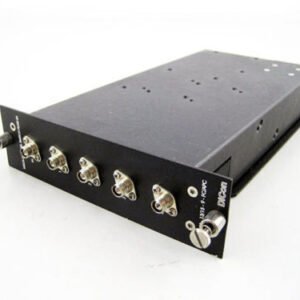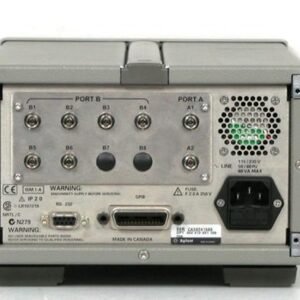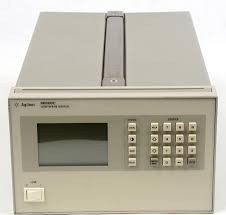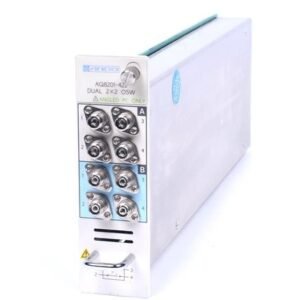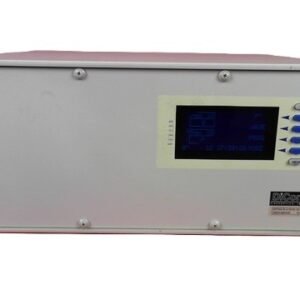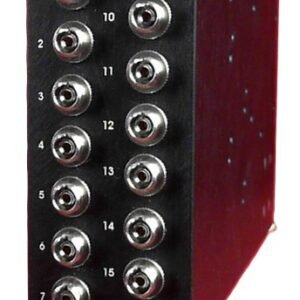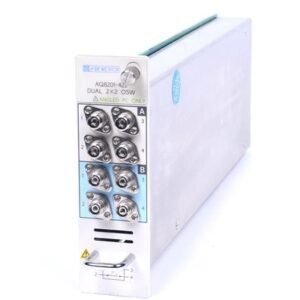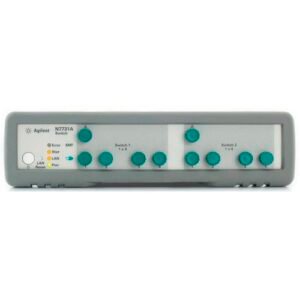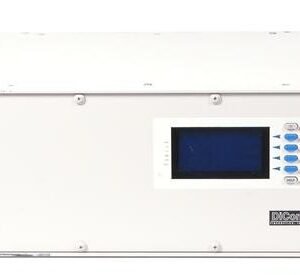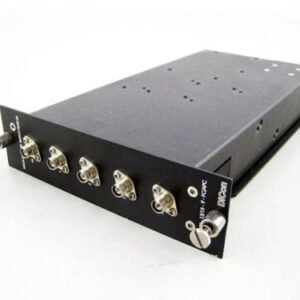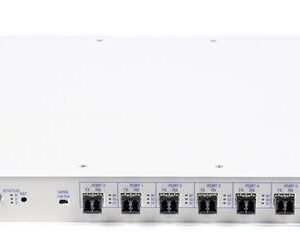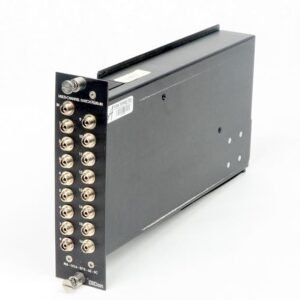

The Photoncom Option Switch A-B 2(1×4) Model PS2U2C1X4C is a manual optical switch that selects one of two input sources and routes the signal to any of four output ports. This hardware-based switching solution eliminates the need for software configuration, delivering straightforward signal path management in applications demanding reliable, direct control. Front-panel operation enables rapid source selection without external control dependencies.
Technical Specifications
Switching Architecture
• Configuration: A-B switch with 2 inputs, 4 outputs
• Control Method: Manual front-panel selection
• Switching Time: Maximum 50 ms
Optical Performance
• Wavelength Range: 1260 nm to 1640 nm
• Insertion Loss: 0.7 dB typical; 1.0 dB maximum
• Crosstalk: -55 dB maximum
• Return Loss: 35 dB (straight connector); 50 dB (angled connector)
• Polarization Dependent Loss: 0.02 dB typical; 0.07 dB maximum
• Repeatability: 0.006 dB typical; 0.05 dB maximum after 100 cycles
• Maximum Input Optical Power: 27 dBm (500 mW)
• Fiber Type: Single-Mode 9/125 µm
• Durability: Over 10 million switching cycles
Electrical Specifications
• Power Supply: 5V DC
• Control Interfaces: RS-232, Ethernet
• RS-232 Operating Voltage: ±9V typical
– Key Features
• Direct hardware switching—no software or complex configuration required
• Low insertion loss maintains signal integrity across all channels
• Excellent crosstalk isolation for reliable multiplexing
• Extended operational lifespan rated for millions of cycles
• Manual front-panel control for independent operation
• Single-mode fiber compatibility for long-distance telecom and test applications
– Typical Applications
• Telecom signal routing and monitoring
• Optical test and measurement setups requiring manual source selection
• Lab environments where hardware-based switching is preferred
• Wavelength-division multiplexing (WDM) test configurations
– Compatibility & Integration
The PS2U2C1X4C integrates with RS-232 and Ethernet control systems. Standard 19-inch rackmount form factor ensures compatibility with typical lab and telecom infrastructures. Single-mode fiber connectors support long-wavelength optical signals across the C and L bands.