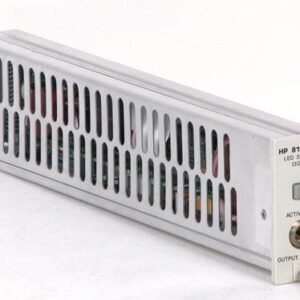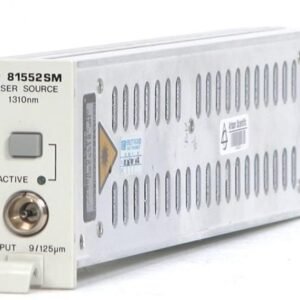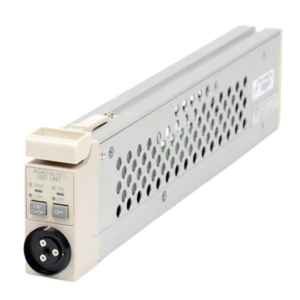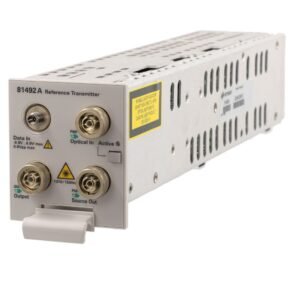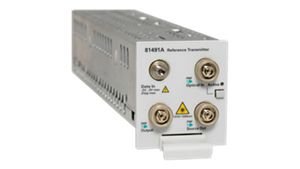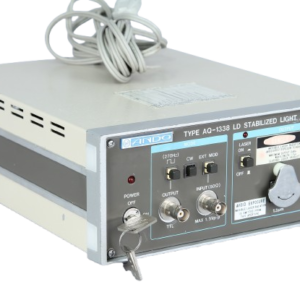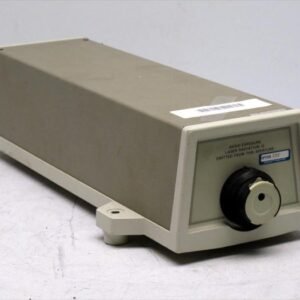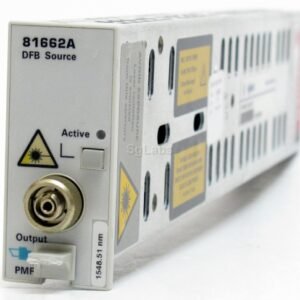

The Photonetics OSICS 3613 CWL DFB Module is a Distributed Feedback laser diode module engineered to deliver stable, single-frequency optical output for demanding test and measurement applications. Operating as a plug-in module within the OSICS mainframe ecosystem, it provides precise wavelength control across ITU-T grid channels in the C- and L-bands, making it ideal for DWDM system characterization, optical communication testing, and sensing deployments.
Technical Specifications
Wavelength selection spans ITU-T grid channels (C- and L-band examples include 1554.13 nm and 1574.54 nm) with a tuning range of 1.6 nm (1.8 nm typical). Wavelength accuracy is ±0.03 nm (±30 pm), with exceptional frequency stability of ±0.005 nm/hour and typical 24-hour drift of ±0.005 nm. Output power is standard at +10 dBm, with a +13 dBm option available. Optical power stability maintains ±0.01 dB/hour typical performance and ±0.01 dB/24 hours.
Spectral characteristics include a narrow linewidth of 145 dB/Hz typical. The module integrates polarization-maintaining fiber (except 1310 nm variants) with FC/APC narrow-key optical connectors.
– Key Features
• Internal and external low-frequency modulation capability (50 Hz to 50 MHz analog; 50 Hz to 1 MHz digital)
• Stimulated Brillouin Scattering suppression
• Compact form factor: 35 × 128 × 230 mm (W × H × D), weighing 1.1 kg
• Single-frequency DFB architecture for applications requiring excellent linewidth performance
– Typical Applications
• Optical communication systems testing and validation
• Dense Wavelength Division Multiplexing (DWDM) system characterization
• Silicon photonics and integrated photonics device testing
• Coarse Wavelength Division Multiplexing (CWDM) applications
• Optical Supervisory Channel (OSC) test configurations
• Optical Time Domain Reflectometry (OTDR) and optical sensing
– Compatibility & Integration
Designed for the OSICS mainframe platform (e.g., OSICS 3610RA00 8-Slot Mainframe), this module combines with up to 7 additional plug-in sources—including tunable external cavity lasers, ASE sources, and EDFAs—enabling flexible multi-wavelength test configurations. Legacy OSICS module compatibility ensures integration into established test systems.