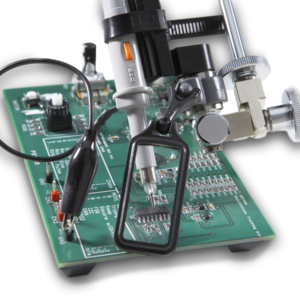

This LPDDR2 memory module delivers low-power, high-performance data storage in a space-constrained Package-on-Package (PoP) form factor. The X32 data width configuration with 240-ball solder termination is optimized for mobile applications requiring direct oscilloscope probe access to signal validation at the solder ball interface.
Technical Specifications
• Memory Type: LPDDR2
• Data Width: X32
• Package Form Factor: Package-on-Package (PoP)
• Ball Count: 240 Ball Scope
• Termination: Solder balls only
• Internal Banks: 4 or 8 (variant-dependent)
• Burst Lengths: Programmable—2, 4, 8, or 16 cycles
• Clock Interface: Differential (CK and CK#), commands sampled on positive CK edge
• Data Strobes (DQS): Bidirectional, one per byte; edge-aligned on READ, center-aligned on WRITE
• Data Masks (DM): One per byte for write data masking
• Input Logic Level: 1.8V LVCMOS-compatible
• Refresh Modes: Auto-refresh, self-refresh, per-bank auto-refresh, concurrent auto-precharge
– Key Features
• Partial-Array Self Refresh (PASR) reduces power by refreshing only active memory regions
• Deep Power-Down (DPD) mode disables the memory array for extended idle periods
• Selectable Drive Strength (DS) optimizes output current for system power budgets
• Clock Stop Capability halts clock signals during dormant states
• Temperature Compensated Self Refresh (TCSR) adjusts refresh timing based on die temperature
• On-Chip Temperature Sensor monitors thermal conditions for refresh rate control
• Pipelined DDR Architecture enables two data accesses per clock cycle
– Typical Applications
Mobile devices, smartphones, tablets, and portable electronics where footprint minimization and ultra-low power consumption are critical design constraints.
– Compatibility & Integration
The PoP stacking configuration places this memory directly above application processors, reducing PCB area. The 240-ball scope designation supports specialized test interposers and fixtures that enable direct oscilloscope probing of signal integrity measurements at solder ball contact points.