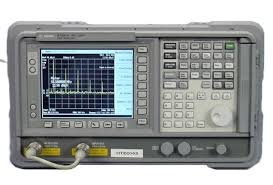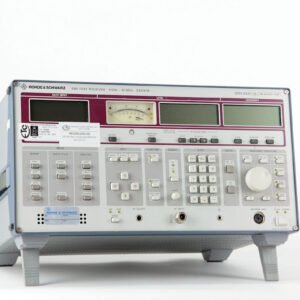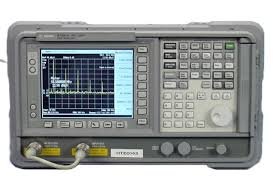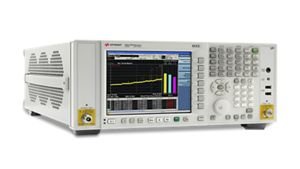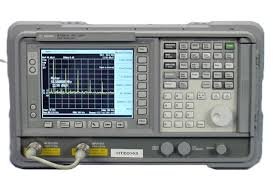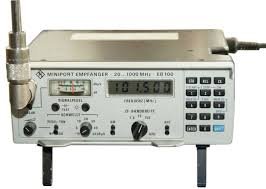

The Rohde & Schwarz ESHS30 is a double-conversion heterodyne EMI test receiver engineered for conducted emissions compliance testing across 9 kHz to 30 MHz. It delivers simultaneous peak, quasi-peak, and average detection with parallel operation capability and minimal measurement error. Purpose-built for test environments where equipment under test (EUT) changes frequently, the ESHS30 serves test houses and quality assurance departments requiring high-accuracy EMI characterization.
Technical Specifications
Frequency & Detection
• Frequency range: 9 kHz to 30 MHz
• Detectors: Peak, quasi-peak, and average (parallel operation with ~0.5 dB error)
• IF bandwidths: 200 Hz and 10 kHz selectable
• Frequency resolution: 10 Hz
Measurement Performance
• Level measurement range: –36 dBm to +137 dBm (–36 to +137 dBµV)
• Dynamic range: 70 dB
• Noise figure: 6 dB (with pre-amplifier), 10 dB (without)
• Third-order intercept point: typically 20 dBm
• Displayed average noise level: –148 dBm (min) to –124 dBm (max)
• Measurement accuracy: typical 0.5 dB error
• Display resolution: 0.1 dB
Signal Processing & Display
• LCD digital level indication with 0.1 dB resolution
• Analog moving coil meter display with transducer factor compensation
• CRT display for graphical measurement and settings presentation
• Built-in IF analyzer for interference spectrum monitoring
• 3.5-inch floppy disk drive (1.44 Mbyte) for data storage and firmware updates
– Key Features
• Storage for up to 22 transducer factors and limit lines
• Macro recording capability for automatic and semi-automatic test sequences
• Flash EPROM firmware with PC update capability
• Full programmability via IEC/IEEE bus
• IEEE488 interface for peripheral device integration
• Manual or processor-controlled operation (internal or external)
– Typical Applications
EMI compliance testing per CISPR 16-1, EN 55011–55022, ANSI C63.2, VDE 0876, VDE 0871–0879, FCC, ETS, and VCCI standards. Suited for high-volume test environments and quality control departments requiring flexible EUT configuration changes.
– Compatibility & Integration
IEEE488 interface enables integration into automated test systems. Programmable functions support custom measurement sequences. Transducer factor memory and limit line storage streamline multi-configuration testing workflows.