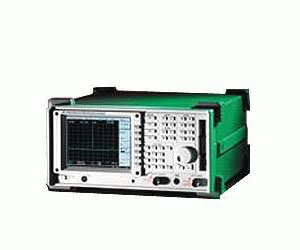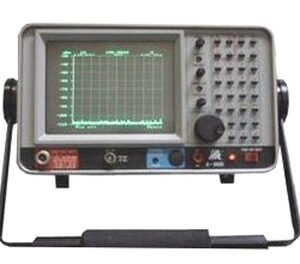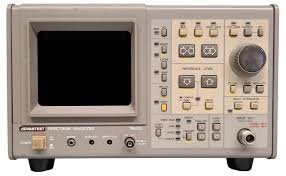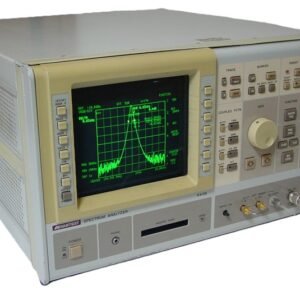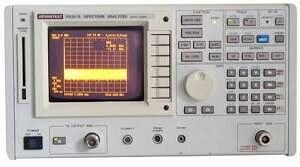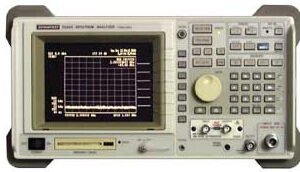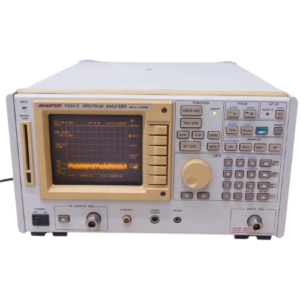
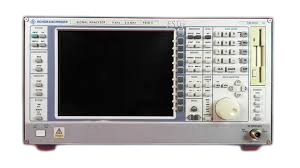

The Rohde & Schwarz FSIG3 is a high-performance spectrum analyzer for signal analysis across frequency, time, and modulation domains. It delivers accurate measurements of modern communication systems through a combination of wide dynamic range, low noise floor, and fast analysis speeds. The instrument integrates spectrum analysis, time domain burst characterization, and vector signal analysis capabilities, making it suitable for development and production testing of mobile radio standards.
Technical Specifications
• Frequency Range: 9 kHz to 3.5 GHz
• Resolution Bandwidth: 1 kHz to 10 MHz (1/2/3/5 steps); FFT filter options down to 1 Hz
• Resolution Filters: 5-pole design with high selectivity
• Displayed Average Noise Floor: Typically -130 dBm (1 kHz bandwidth)
• Third-Order Intercept: +18 dBm
• Phase Noise: -150 dBc(1 Hz) at 5 MHz offset
• Dynamic Range: 75 dB ACPR for WCDMA (4.096 MHz integration bandwidth)
• Level Uncertainty: <1 dB up to 2.2 GHz; <1.5 dB up to 7 GHz
• Detector: RMS detector for waveform-independent power measurement
• Sweep Time: 5 ms full span (frequency domain); 1 µs zero span (time domain)
– Key Features
• Measures intermodulation and harmonics with accuracy across wide intermodulation-free dynamic range exceeding 110 dB
• Burst analysis with gate functions, trigger delay, and integrated RF trigger for TDMA systems
• Transient signal analysis via 1 µs minimum sweep times
• Broadband vector signal analyzer supporting GSM, EDGE, IS-136, cdmaOne, and W-CDMA/3GPP signals
• Multiple result displays: I/Q signal plots, magnitude/phase diagrams, vector and constellation diagrams, tabular modulation error output
• Out-of-band spurious measurement capability to 3.5 GHz maximum input frequency
– Typical Applications
• Mobile radio standard characterization and validation
• Spurious and intermodulation analysis
• TDMA burst signal assessment
• Modulation quality evaluation on 2G and 3G signals
• Production test and quality assurance
– Compatibility & Integration
The FSIG3 shares core architectural capabilities with related R&S FSIQ and FSQ models, supporting flexible measurement workflows in multi-instrument test environments.