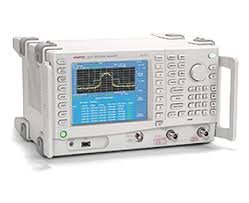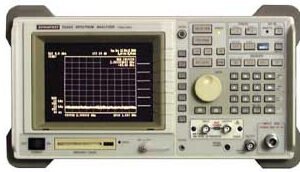

The Rohde & Schwarz FSVA3004 is a signal and spectrum analyzer spanning 10 Hz to 4 GHz, engineered for wireless communications, component testing, and aerospace and defense applications. It delivers a standard analysis bandwidth of 28 MHz, expandable to 400 MHz, with resolution bandwidth tunable from 1 Hz to 10 MHz. The instrument combines a displayed average noise level of –153 dBm (typical) with third-order intercept performance of 20 dBm, enabling detection of weak signals and characterization of highly nonlinear devices. SSB phase noise reaches –120 dBc/Hz at 10 kHz offset with a 1 GHz carrier, improving to –127 dBc/Hz with the B710 option. Sweep time accuracy of ±0.1% (span = 0 Hz) and ±3% (span ≥ 10 Hz) supports both production and laboratory workflows. A multi-touch interface, high measurement speed, and marker resolution of 1 Hz enable rapid signal diagnostics.
Technical Specifications
• Frequency Range: 10 Hz to 4 GHz; with R&S FSV3-B710 option: 2 Hz to 4 GHz
• Resolution Bandwidth: 1 Hz to 10 MHz
• Analysis Bandwidth: 28 MHz standard; 40 MHz, 200 MHz, or 400 MHz options available
• SSB Phase Noise: –120 dBc/Hz (1 Hz) at 10 kHz offset; –127 dBc/Hz with B710 option
• DANL: –153 dBm (typical); –167 dBm with preamplifier option B24
• TOI: 20 dBm (typical)
• Amplitude Range: –162 dBm to +30 dBm
• Maximum Input Power: 30 dBm
• Marker Resolution: 1 Hz
• Power Supply: 100–240 V AC, 50/60 and 400 Hz
• Power Consumption: 120 W nominal; 250 W maximum with options
• Dimensions: 462 mm W × 197 mm H × 417 mm D
• Weight: 12.2 kg
• Storage Temperature: –40 °C to +70 °C
– Key Features
• Tunable resolution bandwidth supports narrow-band and wideband analysis
• Optional preamplifier extends sensitivity to –167 dBm
• Five USB 2.0 and two USB 3.0 Type A ports for data transfer and peripheral control
• LAN 10/100/1000BASE-T with optional 10 Gbit/s upgrade
• External trigger and dual reference input/output connectors
• DVI output standard; optional DisplayPort for extended displays
• Optional GPIB interface for legacy system integration
– Typical Applications
• Spectral characterization of wireless transceivers and RF components
• Production testing of cellular, satellite, and radar systems
• Environmental monitoring and EMI/RFI surveys
• Phase noise and modulation quality assessment
– Compatibility & Integration
The instrument accepts external frequency references and triggers, facilitating integration into automated test racks. LAN connectivity enables remote operation and data logging; USB interfaces support high-speed waveform capture and instrument control.