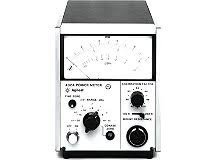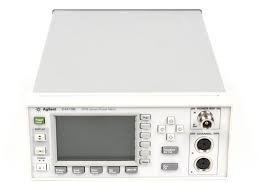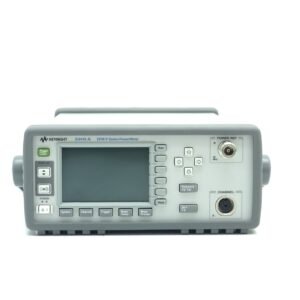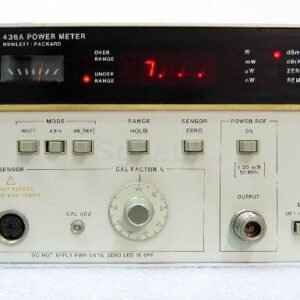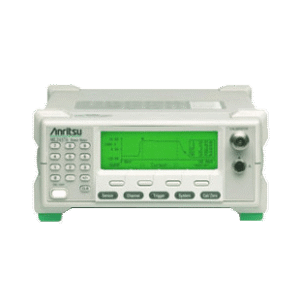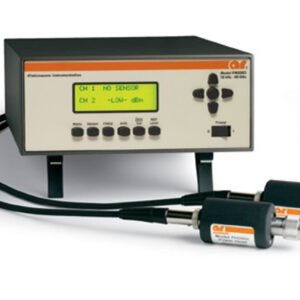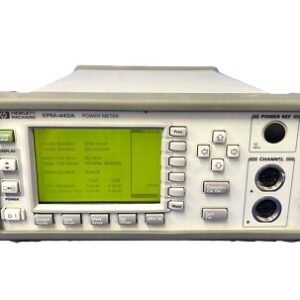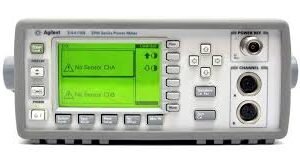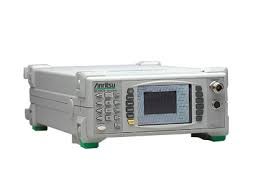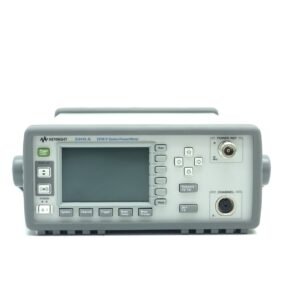
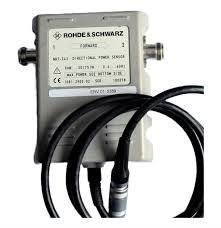

The Rohde & Schwarz NRT is a power reflection meter engineered for precise power measurements across RF and microwave applications. This modular system combines a base unit with interchangeable directional power sensors to deliver accurate average power, peak envelope power, and reflection measurements across mobile communications, R&D, production, and quality assurance environments.
Technical Specifications
Frequency Coverage
• 25 MHz to 1 GHz (NRT-Z14 sensor)
• 200 MHz to 4 GHz (NRT-Z43/Z44 sensors)
• 400 MHz to 4 GHz (NRT-Z44 sensor)
Power Measurement Range
• NRT-Z44: 0.0007 W to 30 W (average) / 75 W (peak); 0.003 W to 120 W (average) / 300 W (peak)
• NRT-Z43: 0.003 W to 120 W (average) / 300 W (peak)
• NRT-Z14: 0.006 W to 120 W (average)
Sensor Performance
• Standing Wave Ratio: 1.06 max. (0.4–3 GHz); 1.12 max. (3–4 GHz); 1.07 max. (0.2–3 GHz)
• Insertion Loss: 0.06 dB max. (0.4–1.5 GHz); 0.09 dB max. (1.5–4 GHz); 0.06 dB max. (0.2–1.5 GHz)
• Directivity: 30 dB min. (0.4–3 GHz); 26 dB min. (3–4 GHz); 30 dB min. (0.2–3 GHz)
• Zero Offset: ±0.001 W
• Temperature Coefficient: 0.25%/K (0.011 dB/K)
• Video Bandwidth: 400 MHz
– Key Features
• Average Power measurement with 35–40 dB range, functioning as a thermal power meter
• Average Burst Power for TDMA timeslot analysis
• Peak Envelope Power with sub-microsecond temporal resolution (200 ns for NRT-Z43/Z44; 1.5 µs for NRT-Z14)
• Peak-to-Average Power Ratio (Crest Factor) in dB
• Amplitude Distribution (CCDF) for non-determined envelope characterization
• Reflection Measurement displaying return loss, SWR, and reflection coefficients
– Typical Applications
The NRT system supports GSM/EDGE, 3GPP (W-/TD-CDMA), CDMA, TETRA, DECT, DAB, and DVB-T standards, accommodating both analog and digital modulation schemes across mobile communications, RF development, transmitter validation, and system characterization.
– Compatibility & Integration
Modular sensor architecture allows frequency and power range selection according to measurement requirements, with each sensor offering tailored performance across distinct frequency bands and power levels.