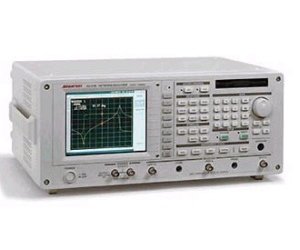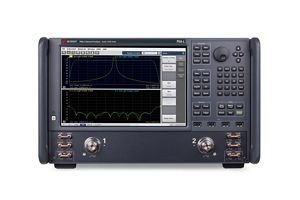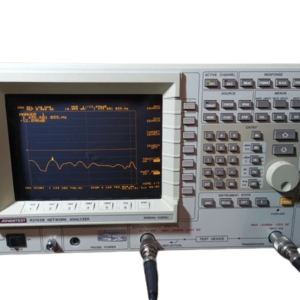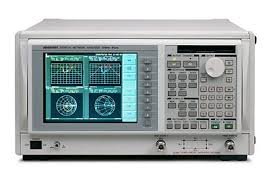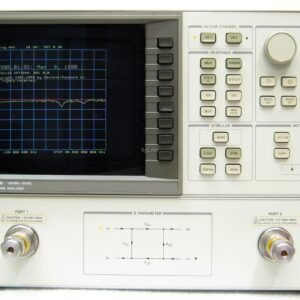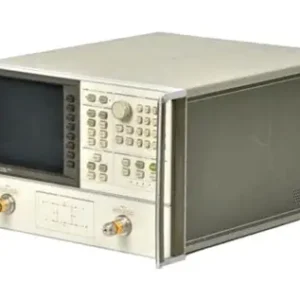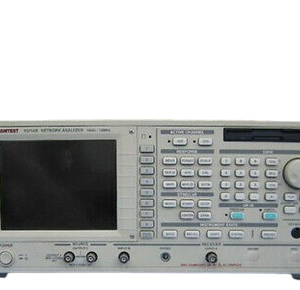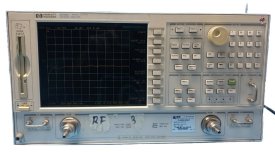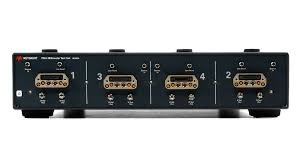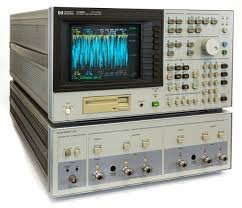
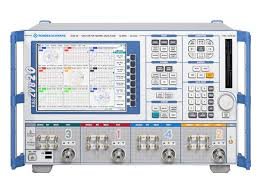

The Rohde & Schwarz ZVB4 is a 2-port vector network analyzer operating from 300 kHz to 4 GHz, engineered for passive and active component characterization in development and production environments. The instrument delivers dynamic range exceeding 123 dB at 1 Hz IF bandwidth, output power above +13 dBm per port, and measurement speeds as fast as 8.4 ms per point. Its multiport architecture supports balanced device analysis, parallel measurements across multiple ports, and simultaneous capture of four reflection parameters on uncoupled 4-port devices. The ZVB4 combines 50 Ω test ports with Type N connectors, integrated DC bias delivery for active DUTs, and a Windows-based interface for intuitive operation and rapid data transfer.
Technical Specifications
Frequency Range: 300 kHz to 4 GHz
Ports: 2-port configuration (4-port version available)
Test Port Impedance: 50 Ω
Test Port Connector: Type N, female
Dynamic Range: Over 123 dB between test ports at 1 Hz IF bandwidth; typical performance exceeds 110 dB, reaching approximately 122 dB at 1 Hz IF bandwidth
Output Power: Maximum +13 dBm per test port, independent of measurement direction
Power Sweep Range: Over 50 dB
Measurement Speed: 8.4 ms per point (10 MHz start, 4 GHz stop, ALC off, 100 kHz measurement bandwidth, full one-port calibration/correction off); minimum 4.5 µs per point under optimized conditions
Trace Stability: Less than 1 dB or < 6° at 0 dBm source power, 0 dB reflection, 1 Hz measurement bandwidth
Temperature Specification: +18 °C to +28 °C, temperature stable within 1 K post-calibration
– Key Features
• Simultaneous multiport and parallel measurements with real-time data transfer
• Balanced device measurement capability for differential and common-mode analysis
• Four reflection parameter acquisition on uncoupled 4-port devices
• DC bias supply integrated into test port inner conductors with rear-panel connectors
• Wide dynamic range optimization at reduced IF bandwidth
• High output power for challenging component characterization
– Typical Applications
• Passive component S-parameter measurement (filters, couplers, attenuators)
• Active device characterization (amplifiers, mixers, switches)
• Differential pair and balanced transmission line analysis
• Production test environments requiring fast throughput
– Compatibility & Integration
Standard 50 Ω measurement infrastructure; Type N connector ecosystem. Windows-based control platform supports industry-standard data formats and integration with automated test systems.