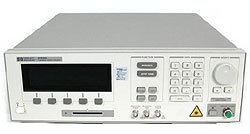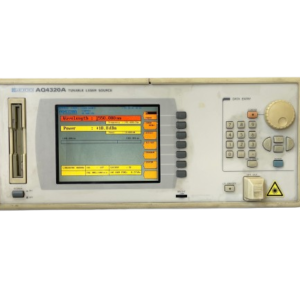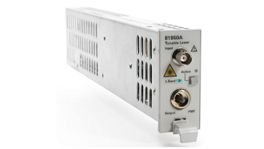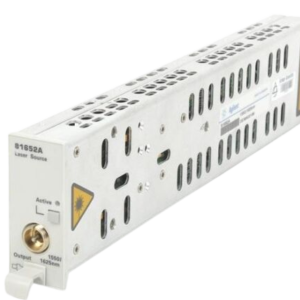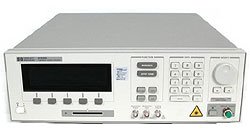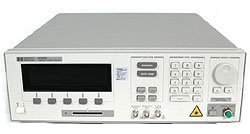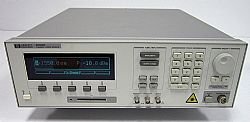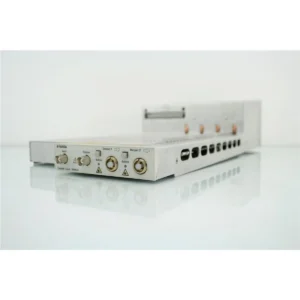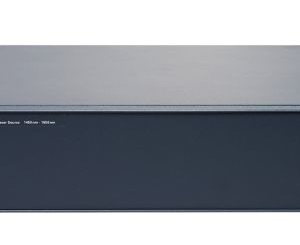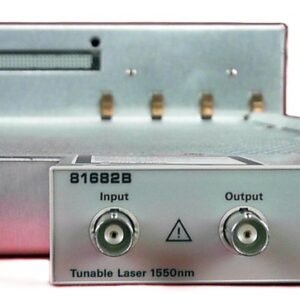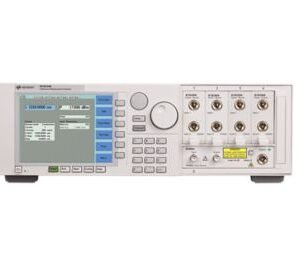
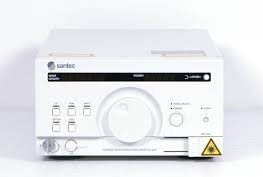

The Santec TSL-210 is a tunable laser source engineered for precision optical testing across telecommunications and photonics applications. It delivers selectable wavelength windows spanning 1260 to 1650 nm with 0.01 nm resolution, 0.1 nm accuracy, and 0.05 nm repeatability. Output power typically exceeds 8 mW with 8% accuracy and 0.2 dB flatness. The instrument combines fast wavelength tuning at 170 ms/nm with variable coherence control, adjustable linewidth from 1 to 500 MHz, and an optional tracking filter for ASE noise suppression. High-power configurations and a pulse variant (30 ps duration, 2.5 GHz repetition rate) extend utility across demanding R&D and production environments.
Technical Specifications
Wavelength Tuning
• Range: Selectable windows 1260–1650 nm; TSL-210F offers continuous 1260–1630 nm (370 nm)
• Tuning bandwidth: 80–100 nm per window; 370 nm for TSL-210F
• Resolution: 0.01 nm (0.001 nm with fine tuning)
• Accuracy: 0.1 nm
• Repeatability: 0.05 nm (n=50, center wavelength)
• Stability: 0.01 nm over 1 hour (center wavelength)
• Fine tuning: 10 GHz or 0.08 nm typical
• Tuning speed: 170 ms/nm
Output Power
• Maximum: >8 mW typical; >10 mW available in select configurations
• High-power option: Reduces to 80% of specification with integrated filter
• Accuracy: 8%
• Repeatability: 0.01 dB (n=50, +6 dBm)
• Stability: 0.01 dB over 1 hour (+6 dBm)
• Flatness: 0.2 dB (+6 dBm)
Spectral Characteristics
• Linewidth: Maximum 1 MHz (coherence control OFF); 1–500 MHz adjustable (coherence control ON)
• ASE noise: Optional tracking filter available for high SNR
Modulation
• Range: 0–10 kHz at −3 dBm
• High-frequency modulation supported
Pulse Variant (TSL-210)
• Duration: 80 nm across full tuning band
– Key Features
• Fully variable coherence control as standard
• Multiple selectable wavelength windows or continuous 370 nm tuning
• Integrated tracking filter option for reduced ASE noise
• High-power output configurations available
• Sub-nanosecond pulse operation with GHz repetition rates
– Typical Applications
• Component characterization and wavelength-dependent testing
• Optical filter and DWDM system validation
• Research across C-, L-, and extended bands
• Production wavelength verification and signal-to-noise ratio assessment
– Compatibility & Integration
The TSL-210 supports high-frequency modulation with configurable input terminals and level requirements detailed in operation documentation.