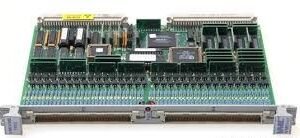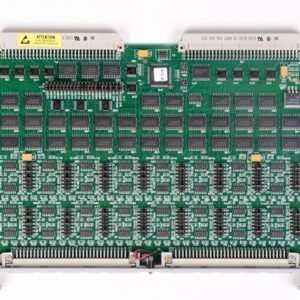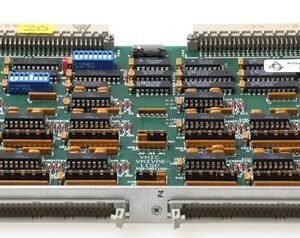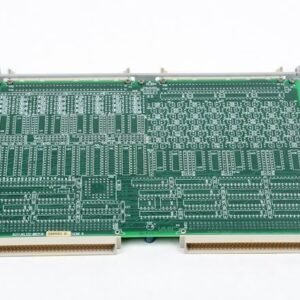

The Sealevel Systems REL-32.PCI is a PCI 2.1-compliant digital interface card delivering 32 channels of normally open reed relay outputs for isolated switching in industrial control, automation, and data acquisition systems. Organized into four parallel ports, the card provides reliable contact closure with a maximum operating speed of 600 Hz and contact ratings up to 100 VDC/VAC at 0.5 A RMS. Each relay exhibits 0.5 mS operate, release, and bounce times with initial contact resistance of 0.15 Ω. The card supports rated life of 200 million closures at low load and 100 million closures at maximum load.
Technical Specifications
• Host Interface: PCI (Standard Profile), PCI 2.1 compliant
• Channels: 32 reed relay outputs in four parallel ports
• Relay Type: DIP Reed Relays, normally open configuration
• Contact Rating: 100 VDC/VAC maximum, 0.5 A AC/DC RMS, 10 W maximum
• Contact Resistance: 0.15 Ω initial
• Contact Timing: 0.5 mS operate; 0.5 mS release; 0.5 mS bounce
• Maximum Operating Speed: 600 Hz
• Rated Life: 200 million closures (low load), 100 million closures (maximum load)
• Power Requirement: +5 VDC @ 560 mA
• Operating Temperature: 0°C to 70°C
• Storage Temperature: -50°C to 105°C
• Humidity: 10-90% RH non-condensing
• PCB Dimensions: 6.60 inches × 4.20 inches (including gold fingers)
– Key Features
• Galvanic isolation via reed relay architecture
• Four-port parallel organization for simplified channel management
• DB-78 male connector with optional cable interface to dual DB-37 connectors (CA172, CA173)
• Direct compatibility with Sealevel TB02 terminal block
• UL 94V0 rated PCB construction, 100% electrically tested
• Multiple adapter support within single system
– Typical Applications
• Industrial automation and process control
• Equipment relay switching and signal routing
• Data acquisition system switching matrices
• Test and measurement signal isolation
– Compatibility & Integration
Supported operating systems include Windows 98/NT/ME/2000/XP, Linux, and DOS. The SeaI/O API provides Windows DLL and Linux kernel module/library implementations with driver functions, sample code, and development utilities. Software installation prior to hardware deployment is recommended.