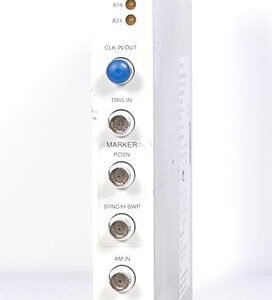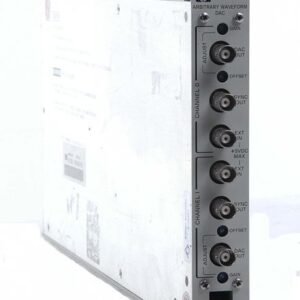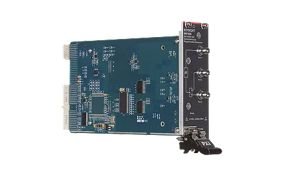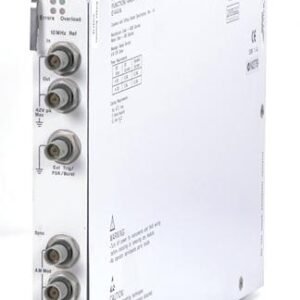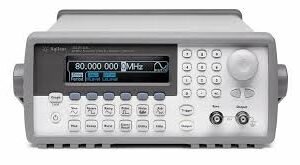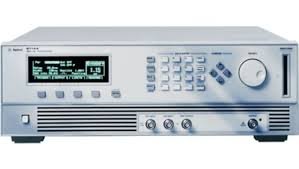
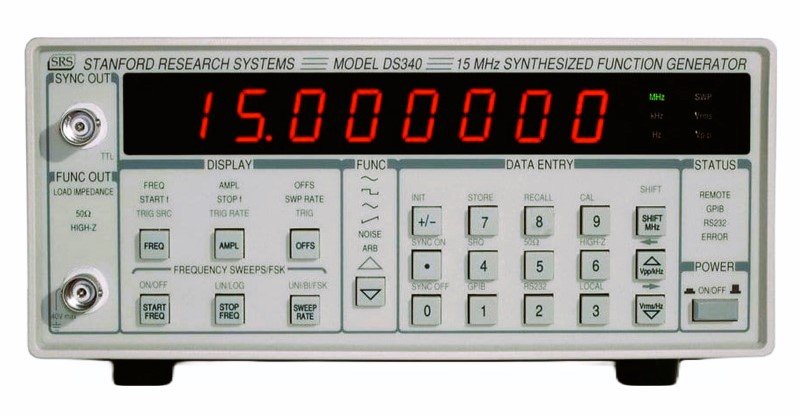

The Stanford Research Systems DS340 is a synthesized function and arbitrary waveform generator employing Direct Digital Synthesis (DDS) technology to deliver precise, stable waveforms across a broad range of test and measurement applications. It generates standard waveforms—sine, square, ramp, and triangle—plus Gaussian white noise and user-defined arbitrary waveforms with 12-bit vertical resolution and sample rates to 40 MHz. The instrument combines high frequency resolution (1 µHz), low phase noise, and excellent harmonic distortion performance, making it suitable for analog circuit characterization, component testing, and signal simulation in laboratory and production environments.
Technical Specifications
Waveform Generation
• Standard waveforms: Sine, Square, Ramp, Triangle, Gaussian White Noise
• Arbitrary waveforms: 8 to 16,300 points at 12-bit resolution; sample rate 40 MHz or integer sub-multiples
• 10 MHz Gaussian white noise generator included
Frequency & Timing
• Sine and Square: 1 Hz to 15.1 MHz
• Ramp and Triangle: 1 Hz to 100 kHz
• Frequency resolution: 1 µHz across all functions
• Timebase accuracy: Standard; optional 2 ppm TCXO timebase (Option 02)
Output Specifications
• Output impedance: 50 Ω
• Amplitude (50 Ω): 50 mVpp to 10 Vpp
• Amplitude (Hi-Z): 100 mVpp to 20 Vpp
• Amplitude resolution: 3 digits
• DC offset (50 Ω): ±5 VDC; (Hi-Z): ±10 VDC
• Offset resolution: 3 digits
Signal Quality
• Sine spurious response: < −65 dBc to 1 MHz (increases 6 dB/octave above 1 MHz)
• Sine harmonic distortion: < −70 dBc (DC–20 kHz); < −60 dBc (20–100 kHz); < −50 dBc (100 kHz–1 MHz); < −40 dBc (1–15 MHz)
• Sine phase noise: < −55 dBc (30 kHz band)
• Square rise/fall time: < 15 ns ± 5 ns (10%–90%); asymmetry < 3 ns + 1% period; overshoot < 2%
• Ramp/Triangle rise/fall time: 45 ns (with 10 MHz Bessel filter); linearity ±0.1% full scale; settling time 200 ns (to 0.5%)
Modulation & Sweeping
• FSK: Internal (max. 50 kHz) and External (TTL, max. 1 MHz)
• Sweeps: Linear and logarithmic, unidirectional and bidirectional, phase-continuous
• Rear-panel SWEEP output for external device synchronization
– Key Features
• Direct Digital Synthesis for frequency accuracy and stability
• Arbitrary waveform capability with extended point count and fast update rates
• Dual-range output impedance (50 Ω and Hi-Z) for flexible load matching
• Integrated FSK and sweep functions with external trigger support
• Low harmonic distortion across extended frequency range
– Typical Applications
• Analog filter and amplifier characterization
• Component and device testing requiring precise stimulus signals
• Signal simulation and circuit validation
• Frequency-sweep measurements and frequency response analysis
– Compatibility & Integration
The rear-panel SWEEP output and external FSK input enable synchronization with automated test systems and external measurement hardware.