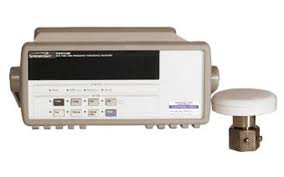
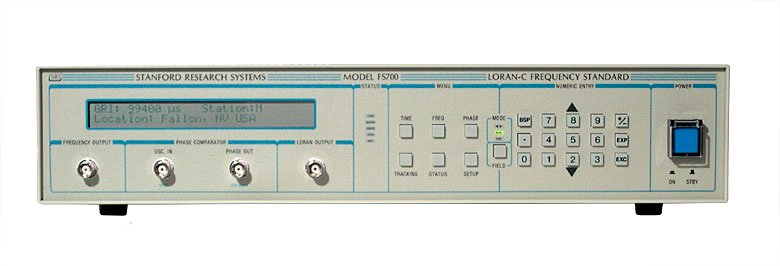

The Stanford Research Systems FS700 is a LORAN-C frequency standard that locks an oven-stabilized crystal oscillator to LORAN-C radio transmissions controlled by cesium clocks, delivering a 10 MHz output with stability comparable to atomic cesium standards at significantly lower cost. The instrument provides NIST traceable frequency references for research, development, and production environments across the USA, Europe, and Asia. Its integrated receiver combines amplifiers, filters, and data acquisition circuitry with a remote antenna to establish reliable long-term frequency locking.
Technical Specifications
Frequency Output
• Four rear-panel 10 MHz sine wave outputs
• Front-panel adjustable frequency TTL output: 0.01 Hz to 10 MHz (1, 2.5, 5 sequence)
• Long-term stability: Comparable to cesium clock standards
• Short-term stability: 10⁻¹⁰ (10⁻¹¹ optional)
Phase Detector
• Measures phase shift between external timebase and internal frequency source
• Calibrates precision oscillators from 100 kHz to 10 MHz
• Output: 0.01 V/degree across 0 to ±360° range
Oscillator Input
• Input impedance: 1 kΩ
• Input voltage range: 0.5 V to 5.0 V
– Key Features
• Four dedicated 10 MHz outputs for simultaneous multi-channel applications
• Programmable TTL output with flexible frequency selection
• Integrated phase detector for precision oscillator characterization
• IEEE-488 GPIB control for automated measurement systems
• Optional RS-232 serial interface (300–19,200 baud)
• Low phase noise oscillator option available
• Lightning protection module available
• Replacement antenna (O700ANT) supported
– Typical Applications
• Frequency calibration and verification in metrology labs
• Atomic clock synchronization validation
• Precision oscillator testing and characterization
• Time and frequency standard distribution
• Production test environments requiring NIST traceability
– Compatibility & Integration
IEEE-488 GPIB interface enables direct integration into automated test systems. Optional RS-232 interface accommodates legacy serial-based control architectures.