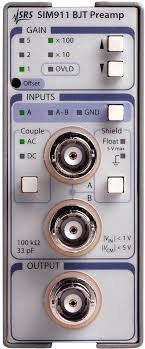

The Stanford Research SIM911 is a low-noise BJT preamplifier designed to amplify weak analog signals from DC to 1 MHz with exceptional input noise performance and programmable gain settings from 1 to 100. Optimized for integration within the SIM900 Mainframe ecosystem, the module operates independently with appropriate DC power and delivers stable, accurate amplification across configurable input modes and coupling options.
Technical Specifications
• Frequency Range: DC to 1 MHz (gain-independent bandwidth); -3 dB at 1.9 MHz typical
• Input Noise: 1.8 nV/√Hz @ 1 kHz (Gain ≥ 10); 12 nV/√Hz @ 1 kHz (Gain = 1)
• Input Current Noise: ~1.2 pA/√Hz
• Input Impedance: 100 kΩ in parallel with ~35 pF
• Programmable Gain: 1 to 100 (1-2-5 sequence)
• Gain Accuracy: ±0.5% (DC to 100 kHz); ±5% @ 1 MHz typical
• Gain Stability: 200 ppm/°C
• CMRR: 85 dB
• AC Coupling Option: 0.7 Hz -3 dB frequency
• Power Requirements: +5 V (50 mA typical, 100 mA max); ±15 V (50 mA typical, 300 mA max)
– Key Features
• Configurable differential (A-B), single-ended (A), or internally grounded input modes
• DC or AC coupling selectable; BNC shield floating or grounded option
• Dual parallel outputs (front and rear panel); rear and front outputs share a common connection
• Clock-stopping microcontroller architecture eliminates digital noise contamination
• Remote serial interface control with front panel button adjustment capability
• Overload indication status signal
– Typical Applications
• Precision measurement of low-amplitude analog signals
• Lock-in detection and signal recovery
• Sensor front-end amplification
• Transducer signal conditioning
– Compatibility & Integration
Single-wide SIM module format with BNC connectors. Operates standalone or integrated within SIM900 Mainframe systems. Output drive capability: one 50 Ω load while the parallel output connects to high impedance loads.