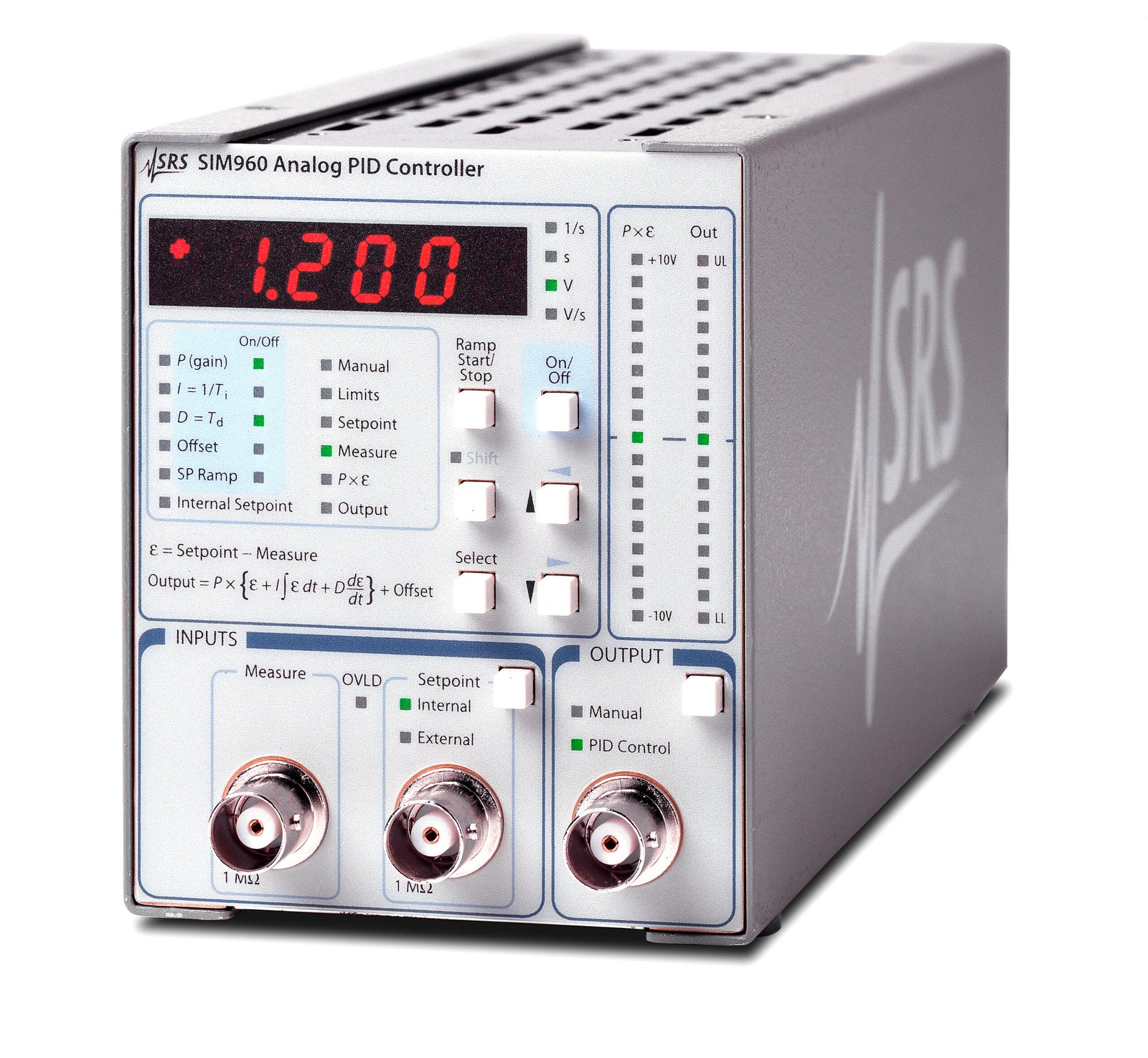

The Stanford Research Systems SIM960 Analog PID Controller is a high-bandwidth control module that combines analog signal conditioning with precision PID regulation for demanding closed-loop applications. Operating with 100 kHz bandwidth and 1 µs propagation delay, it delivers stable control without digital artifacts while maintaining 8 nV/√Hz input-referred noise for sensitive measurements. The module integrates fully into the SIM900 Mainframe ecosystem, offering computer-programmable PID parameters, anti-windup protection, and bumpless manual-to-automatic transfer.
Technical Specifications
• Control Architecture: Analog PID + Offset
• Bandwidth: 100 kHz
• Propagation Delay: 1 µs (typical)
• Input-Referred Noise: 8 nV/√Hz above 10 Hz
• User Gain: Up to 1000×
• Input Range: ±10 V
• Common Mode Range: ±1 V
• Offset Adjustment: ±10 V with 1 mV resolution
• Parameter Accuracy: 1%
• Parameter Resolution: 0.5% (P, I, D, Offset)
• Temperature Stability: 200 ppm/°C
– Key Features
• PID Tuning Ranges: P from 10⁻¹ to 10³; I from 10⁻¹ to 10⁵ s⁻¹ (time constant 10⁻⁵ to 10 s); D from 10⁻⁷ to 1 s
• Conditional Integration: Anti-windup electronics for rapid saturation recovery
• Smooth Output Clamping: Upper and lower limits protect against system overload
• Setpoint Control: Analog input with smooth ramping; front-panel BNC connector; internal ±10 V range at 1 mV resolution
• Bumpless Transfer: Seamless transitions between manual and PID modes
• Real-Time Monitoring: Amplified error signal, output, setpoint, and measured input displayed via LED bar or millivolt numeric display
– Typical Applications
Temperature regulation, laser frequency stabilization, pressure control, and other high-bandwidth feedback systems requiring low-noise analog control without digital sampling artifacts.
– Compatibility & Integration
Designed exclusively for the SIM900 Mainframe. Connects via 15-pin D-sub for power and serial communication. Fully programmable via RS-232 or optional GPIB (IEEE-488.2). Operates within SIM900’s eight-slot architecture with synchronized 10 MHz reference clock.