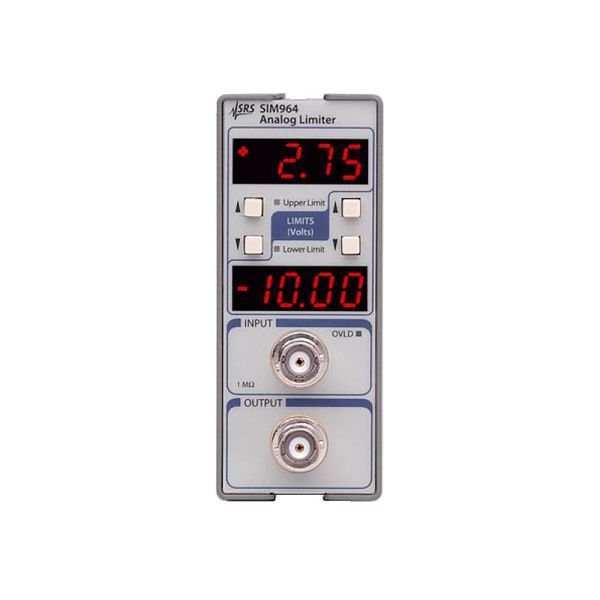

The SRS SIM964 Analog Limiter is a signal conditioning module that enforces upper and lower voltage limits on analog signals within the SIM900 Mainframe ecosystem. It delivers 1 MHz bandwidth with independently programmable limit thresholds across ±10 V, 10 mV resolution, and soft-limit operation over a 100 mV range. The module combines a fully analog signal path with digital programmability, achieving <400 µVrms output noise and 0.01% THD at 1 kHz while employing SRS's clock-stopping architecture to suppress digital noise artifacts.
Technical Specifications
• Bandwidth: 1 MHz
• Upper/lower voltage limits: ±10 V, independently settable
• Limit resolution: 10 mV
• Limit type: Soft limit, 100 mV range
• Input impedance: 1 MΩ
• Output impedance: 50 Ω
• Output noise: <400 µVrms
• Total harmonic distortion: 0.01% (80 dB) at 1 kHz
• Slew rate: 20 V/µs
• Signal path: Fully analog with digital programmability
• Front panel: 2× BNC (input/output)
• Rear panel: 2× BNC (TTL limit detection), 1× DB15 male (SIM interface)
• Power: ±15 V (50 mA typical, 300 mA max), +5 V (50 mA typical, 100 mA max)
• Operating temperature: 0 °C to 40 °C, non-condensing
• Dimensions: 1.5" H × 3.6" W × 7.0" D
• Weight: 1.5 lbs
– Key Features
• Soft limiting with 100 mV transition zone prevents signal clipping artifacts
• TTL limit detection outputs signal when voltage thresholds are exceeded
• Clock-stopping architecture minimizes digital noise in the analog signal path
• Operates within SIM900 Mainframe or standalone with user-supplied ±15 V / +5 V power
• Serial interface supports remote control at 9600 Baud, 8-bit, 1 stop bit, no parity
– Typical Applications
• Signal conditioning in precision measurement systems
• Voltage threshold enforcement in control applications
• Protection circuits requiring soft-limit behavior
• Multi-module signal processing within SIM900 chassis
– Compatibility & Integration
Designed for the SRS SIM900 Mainframe (accommodates up to eight modules). Can operate independently using external ±15 V / +5 V DC supplies and appropriate cabling. Remote operation via serial interface allows computer control alongside front-panel configuration.