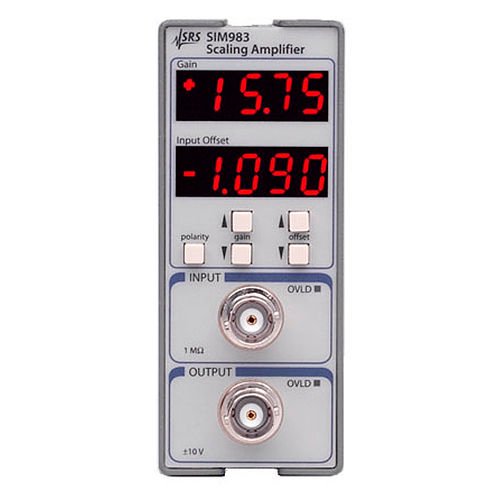

The Stanford Research Systems SIM983 is a modular scaling amplifier that conditions analog signals with adjustable gain and offset across a DC to 1 MHz bandwidth. Designed for the SIM (Small Instrumentation Modules) family, it delivers 3½-digit resolution offset adjustment and precise gain control from ±0.01 to ±19.99 in 0.01 steps. The module operates with low input noise and high slew rate performance, making it suitable for sensitive measurement applications where signal integrity is critical.
Technical Specifications
• Bandwidth: DC to 1 MHz
• Gain Range: ±0.01 to ±19.99 (0.01 resolution)
• Offset: ±10 V with 3½-digit resolution
• Input Impedance: 1 MΩ
• Input Noise: 45 nV/√Hz @ 1 kHz
• Slew Rate: 70 V/µs
• Total Harmonic Distortion: 0.003% (90 dB) @ 1 kHz
• Input Voltage (Max.): ±10 V
• Output Voltage (Max.): ±10 V
• Operating Temperature: 0 °C to 40 °C, non-condensing
• Dimensions: 1.5″ W × 3.6″ H × 7.0″ D
• Weight: 1.5 lbs
– Key Features
• Clock-stopping microcontroller architecture minimizes digital noise during analog signal conditioning
• Remote gain and offset adjustment via SIM interface serial communication
• Front and rear BNC connectors for flexible signal routing
• Dual power supply operation: +5 VDC (100 mA max.) and ±15 VDC (300 mA max.)
• Compact form factor integrates into existing SIM mainframe systems
– Typical Applications
• Low-level signal amplification in research and development
• Precision analog signal conditioning in measurement systems
• Manufacturing test environments requiring stable gain and offset control
• Applications demanding sub-microsecond settling with minimal noise injection
– Compatibility & Integration
The SIM983 operates as a module within the SIM family and integrates with the SIM900 Mainframe for centralized control via RS-232 or GPIB. Standalone operation is possible when external DC power supplies (+5 VDC and ±15 VDC) are provided. Communication with the module occurs through the DB15 male SIM interface connector.