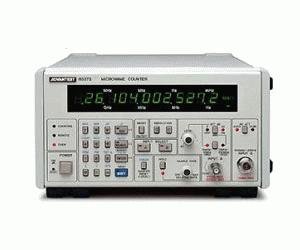
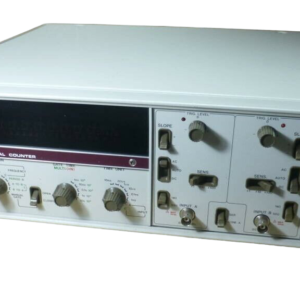
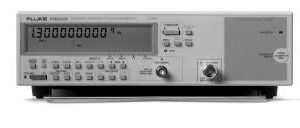
The Stanford Research SR625 Time Base is a precision frequency counting standard that combines rubidium atomic timebase accuracy with high-speed measurement capability. It integrates the SR620 frequency counter, a PRS10 rubidium timebase, and a 2 GHz prescaler to deliver direct frequency measurements up to 2 GHz with 12-digit resolution over 100-second intervals. NIST traceable and field-deployable, the SR625 stabilizes communication systems, calibrates transmitters and base stations, and serves laboratory metrology applications with sub-10-minute warm-up time.
Technical Specifications
Timebase & Stability
• Rubidium atomic timebase (PRS10)
• 10 MHz rubidium-stabilized output
• Short-term stability: 1 × 10⁻¹⁰ Allan variance (1 second); 3.16 × 10⁻¹¹ (10 seconds); 1 × 10⁻¹¹ (100 seconds)
• Long-term drift: ≤ 5 × 10⁻¹¹/month; ≤ 5 × 10⁻¹⁰/year
• Accuracy at shipment: ± 5 × 10⁻¹¹
• One-day stability: 4 × 10⁻¹¹/day
Frequency Measurement
• Direct measurement range: DC to 2 GHz
• Prescaler input range: 50 MHz – 2.0 GHz
• Frequency resolution: 11 digits (1-second gate); 12 digits (100-second measurement)
• Single-shot time resolution: 25 ps
• Frequency resolution: 7 digits/s
Prescaler Input
• Impedance: 50 Ω
• Maximum input level: +23 dBm
• Output: 1/10 input frequency, square wave, 700 mV peak-peak, +500 mV DC offset (50 Ω termination)
Measurement Modes
Frequency, period, time interval, ratio, totalize; phase resolution: 0.001°
Power & Physical
• AC input: 100 V, 120 V, 220 V, or 240 V nominal; 50 or 60 Hz
• Power consumption: 70 W
• Fuses: 1 A slow-blow (100/120 V); 0.5 A slow-blow (220/240 V)
• Warm-up time: < 10 minutes
• Three-wire detachable power cord
– Key Features
• Atomic-grade frequency standard for calibration and metrology
• 12-digit resolution enables precision frequency verification
• Dual interfaces (GPIB, RS-232) for automated measurement and control
• Low power consumption supports both lab and field deployment
• NIST traceability ensures measurement confidence
– Typical Applications
• Base station and transmitter frequency calibration
• Communication system synchronization
• Precision frequency counting and verification
• Long-term timebase stability monitoring
– Compatibility & Integration
GPIB (IEEE-488) and RS-232 interfaces enable integration with automated test systems and data acquisition platforms.