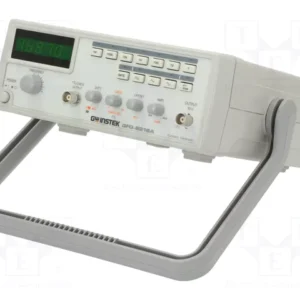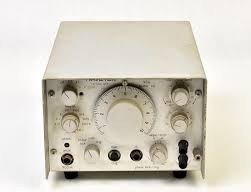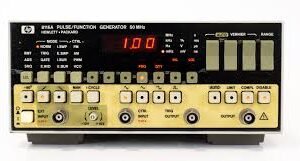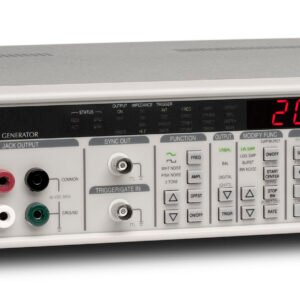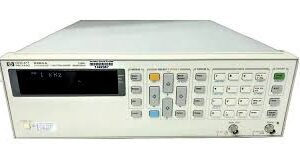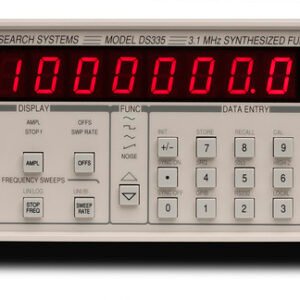

The Stanford Research Systems DS335 is a 3 MHz function generator delivering precise waveform synthesis across a 0.1 Hz to 3 MHz range. This instrument combines standard waveform generation with arbitrary signal creation, modulation capabilities, and flexible triggering to support laboratory testing, R&D, and system integration tasks. Frequency resolution extends to 1 µHz with ±20 ppm annual accuracy and ±0.1 ppm/°C stability, enabling demanding measurement and signal conditioning applications.
Technical Specifications
Signal Generation
• Frequency Range: 0.1 Hz to 3 MHz
• Waveform Types: Sine, Square, Triangle, Ramp (Up/Down), Arbitrary (user-definable)
• Frequency Resolution: 1 µHz
• Frequency Accuracy: ±20 ppm over one year
• Frequency Stability: ±0.1 ppm/°C (typical)
• Output Amplitude: 1 mVp-p to 10 Vp-p (50 Ω load), 1 mV resolution, ±(2% + 1 mV) accuracy
• DC Offset: ±5 V (50 Ω load), 1 mV resolution, ±(2% + 1 mV) accuracy
• Output Impedance: 50 Ω nominal
Modulation & Sweep
• AM: Internal sine/square/triangle sources (1 Hz to 10 kHz), external input, 0–100% depth
• FM: Internal sine/square/triangle sources (1 Hz to 10 kHz), external input, adjustable deviation
• Sweep: Linear and logarithmic modes, 1 ms to 100 s rate, bidirectional, triggered operation
Arbitrary Waveforms
• Memory: 16k points
• Sampling Rate: Up to 10 MS/s
• Vertical Resolution: 12-bit
Triggering & Synchronization
• External Trigger: TTL compatible
• Trigger Modes: Internal, External, Manual, Line Sync
• Burst Mode: Cycle or duration-based generation
– Key Features
• 1 µHz frequency resolution enables fine-grain signal tuning
• Five waveform types plus 16k-point arbitrary memory for custom signals
• Dual modulation modes (AM and FM) with internal and external sources
• Linear and logarithmic sweep with rates from 1 ms to 100 s
• Burst mode for gated signal generation
• TTL-triggered synchronization to external events
– Interfaces & Control
IEEE-488 (GPIB) and RS-232 interfaces support remote automation and test system integration. Front-panel controls provide manual operation and display access.
– Typical Applications
• Circuit testing and signal characterization
• Frequency response measurement
• Audio and ultrasonic signal generation
• Modulation technique validation
• System synchronization and triggering
– Compatibility & Integration
The 50 Ω output impedance matches standard RF test equipment. GPIB and RS-232 connectivity enable headless operation and integration into automated test platforms. Standard 19-inch rack-mountable chassis (15 lbs) suits laboratory and production environments. Power requirement: 100–120 VAC or 200–240 VAC, 47–63 Hz; <50 W consumption.