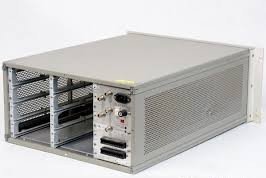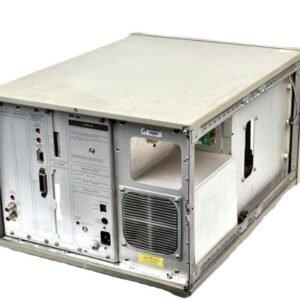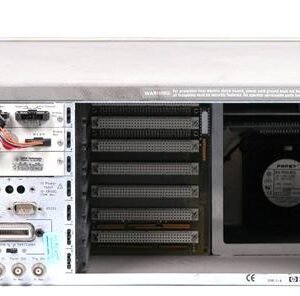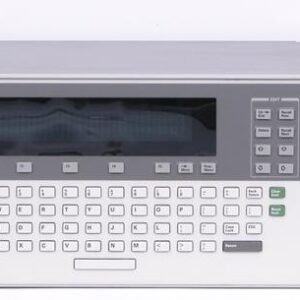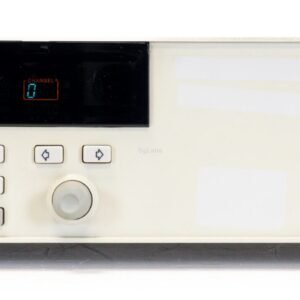

The Stanford Research Systems SIM900 Mainframe is a modular instrumentation platform that houses up to eight Small Instrumentation Modules (SIMs) in a compact, lab-grade chassis. It provides centralized power distribution, host communication, and master clock synchronization across all installed modules, enabling custom measurement systems to be assembled from specialized module components. Operation is available from both front-panel controls and computer interfaces.
Technical Specifications
Module Architecture
• Eight internal slots accommodate single-width and double-width SIM modules
• One external module port via rear-panel connector with interconnect cable
• Regulated and filtered DC power: ±5 V, ±15 V, +24 V
• Force-air cooled power supply with current limiting, over-voltage, and short-circuit protection
Timebase & Synchronization
• Master 10 MHz clock reference generated from low-noise crystal oscillator
• All modules lock to master timebase to eliminate low-frequency mixing products
• Optional external 10 MHz phase-lock input (Option 02) via rear-panel BNC
Memory & Control
• 4000 bytes non-volatile memory for start-up command sequences
• LED status indicators for host interface, timebase sync, communications, script execution, and power
Power Input
• Universal AC supply: 90 VAC to 260 VAC, 47 Hz to 63 Hz
• Internal line fuse (non-user-serviceable)
– Key Features
• RS-232 host interface (DB9/F DCE) with optional GPIB (IEEE-488.2)
• Two auxiliary RS-232 ports for daisy-chaining multiple mainframes or instruments
• Dedicated eavesdrop RS-232 port for communications monitoring and debugging
• Weight: 12.6 lbs (empty chassis)
• Rugged, compact design optimized for laboratory deployment
– Typical Applications
Research and development environments requiring custom-configured measurement systems with synchronized, multi-module instrumentation. Suitable for proximity-critical experiments using external modules and for setups requiring master-clock phase-locking to external references.
– Compatibility & Integration
Accommodates the full range of Stanford Research Systems SIM modules. Master and auxiliary RS-232 interfaces support integration with third-party RS-232 instruments and multiple mainframe cascading within a single control architecture.