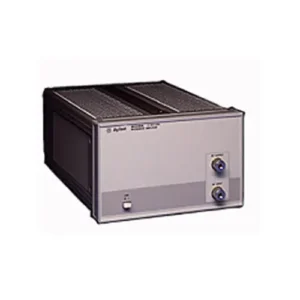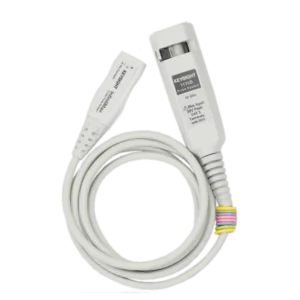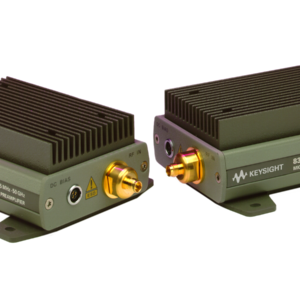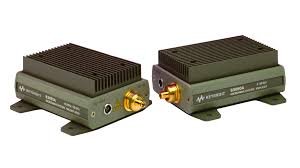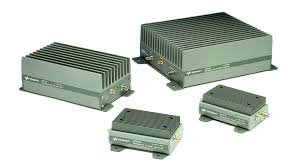

The Stanford Research Systems SR440 is a DC-coupled fast preamplifier spanning DC to 300 MHz, purpose-built for amplifying weak signals across time-domain, RF, and microwave measurement systems. Four independent wide-bandwidth amplifier stages deliver selectable gains of 5, 25, 125, and 625 V/V when cascaded, with fast rise time and low-noise performance that preserves signal integrity in demanding applications. Input dynamic range spans ±200 mV; maximum output is ±1.0 V. The 50 Ω input impedance accommodates standard RF source coupling while maintaining broad bandwidth performance. DC coupling eliminates AC-only constraints, making the SR440 equally effective for transient capture and continuous signal monitoring.
Technical Specifications
• Bandwidth: DC to 300 MHz
• Gain: 5, 25, 125, 625 V/V (cascadable configuration)
• Channels: 4 independent amplifier stages
• Input Range: ±200 mV
• Output Range: ±1.0 V
• Input Impedance: 50 Ω
• Coupling: DC coupled
• Rise Time: Fast
• Noise Figure: Low noise
• Power Supply: 100, 120, 220, 240 VAC; 50/60 Hz
• Power Consumption: 0.25 A @ 100/120 VAC; 0.125 A @ 220/240 VAC
• Weight: 0.93 kg (2.05 lbs)
– Key Features
• Four cascadable gain stages eliminate the need for external summing networks
• Fast transient response with minimal overshoot
• Low-noise design optimized for single-photon and RF detector systems
• DC coupling extends measurement bandwidth into the sub-Hz regime
• Compact form factor suitable for bench and rack integration
– Typical Applications
• Photomultiplier tube (PMT) and photodiode signal conditioning
• Time-domain measurement systems
• RF and microwave signal acquisition
• Fast pulse detection and characterization
• General-purpose high-frequency preamplification
– Compatibility & Integration
The SR440 accepts standard 50 Ω source impedance, making it compatible with commercial RF test equipment, oscilloscopes, and spectrum analyzers. Output impedance matches standard 50 Ω transmission line systems. Universal AC mains compatibility (100–240 VAC) supports laboratory deployment across regions.